
 |
 |
 |
 |
 |
 |
 |
 |
 |

 |
Lowering Solar Cell Cost With New HCT MaxEdge Wire Saw
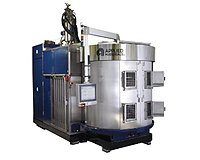
Santa Clara CA (SPX) Mar 17, 2009 Applied Materials has released its Applied HCT MaxEdge wire saw, a new platform for slicing ingots into ultra-thin wafers that can help customers drive down the cost of manufacturing photovoltaic (PV) cells by up to $0.18 per watt. Key technical advances, including an industry-first dual-wire management system, enable the MaxEdge system to deliver significantly higher throughput and load capacity than competitive systems, while requiring much less factory floor space and fewer operators for equivalent megawatt output. By making thinner wafers, PV cell manufacturers can reduce the amount of silicon per wafer and lower the cost-per-watt of solar electricity. To produce thinner wafers, traditional wire saws must reduce the ingot length (load) and the cutting speed. The uniquely designed MaxEdge system delivers ultra-thin wafers without sacrificing throughput by enabling larger loads and using thinner wires at higher cutting speeds. "With the MaxEdge system we've boosted the wafer output and lowered the operating expenses of our industry-leading Applied HCT B5 system, making the best wire saw on the market even better," said Stefan Schneeberger, vice president and general manager of Applied Materials' Precision Wafering Systems division. "The MaxEdge system builds on a 25-year history of wire saw innovation and incorporates key feedback from our customers. Since the wafer is the most expensive component of crystalline silicon-based PV manufacturing flow, reducing wafer fabrication cost is critical to the goal of making solar energy competitive with grid power." Share This Article With Planet Earth
Related Links Applied Materials All About Solar Energy at SolarDaily.com
 Atmospheric Sunshade Could Reduce Solar Power Generation
 Washington DC (SPX) Mar 17, 2009
The concept of delaying global warming by adding particles into the upper atmosphere to cool the climate could unintentionally reduce peak electricity generated by large solar power plants by as much as one-fifth, according to a new NOAA study. |
|
|

| The content herein, unless otherwise known to be public domain, are Copyright 1995-2007 - SpaceDaily.AFP and UPI Wire Stories are copyright Agence France-Presse and United Press International. ESA Portal Reports are copyright European Space Agency. All NASA sourced material is public domain. Additional copyrights may apply in whole or part to other bona fide parties. Advertising does not imply endorsement,agreement or approval of any opinions, statements or information provided by SpaceDaily on any Web page published or hosted by SpaceDaily. Privacy Statement |
 del.icio.us
 Digg
Digg Reddit
 YahooMyWeb
 Google
 Facebook