
 |
 |
 |
 |
 |
 |
 |
 |
 |

 |

Beijing, China (XNA) Oct 07, 2010 A chief designer with China's second lunar probe project has said that the country's lunar pursuit, while lagging behind Russia and the United States for more than 40 years, is still important because space exploration is part of the country's responsibility towards mankind. "The most fundamental task for human beings' space exploration is to research on human origins and find a way for mankind to live and develop sustainably," said Qian Weiping, chief designer of the Chang'e-2 mission's tracking and control system. Chang'e-2 blasted off on a Long-March-3C carrier rocket from the Xichang Satellite Launch Center, in southwest China's Sichuan province, at about 7 p.m. Friday. "As a major country, China has the responsibility to participate in the activities of outer space for peaceful use and make its own contributions," Qian said. Chang'e-2 is China's first unmanned spacecraft to be boosted from the launch site directly to the earth-moon transfer orbit, vastly reducing the journey time from that of its predecessor, Chang'e-1. To acquire more detailed moon data, Chang'e-2 will enter a lower lunar orbit about 100 km above the surface, compared with the 200-km altitude of Chang'e-1, according to the control center. Qian pointed out that China's pursuit of lunar probes and manned space flights was more out of a sense of responsibility than the need to follow in the footsteps of other countries. "Once our mind is made up, we will do it no matter how many years later," Qian said. "However, we can never go beyond scientific rules and find a shortcut." "What we're doing now is what some others already did 40 years ago. But that doesn't necessarily mean that we're lagging behind by 40 years," Qian said, adding that the country's levels of telecommunication, networks and scientific understanding, based on the progress in science and technology, were much more advanced than what they were decades ago. "And we will shorten the gap fast," he added. Some 40 years ago, Russia and the United States were the only countries to have sent people into space. During the U.S. Apollo 11 mission in 1969, Neil Armstrong became the first person to walk on the moon. Qian said that China's space talents were outstanding and young. The average age of the design team for the country's manned project and lunar probe project was just a little over 30 years old, he added. China launched its first lunar probe, Chang'e-1, in October 2007, marking a milestone in the country's space exploration journey. Qian noted that a lunar probe was only the first step in China's quest for deep space exploration. "We will walk on this road step by step - scientifically and gradually," he added.
related report Chang'e-2, following instructions from the center, started the first braking at 11:06 a.m. and entered the 12-hour elliptical moon orbit 32 minutes later. It was the first braking for Chang'e-2. The satellite needs to brake another two times before it can enter the designed 118-minute working orbit. The braking "laid a solid foundation" for Chang'e-2 to carry out scientific explorations in its final orbit, BACC said in a press release. Compared with Chang'e-1, it is more challenging for Chang'e-2 to brake as it must do so at a closer distance to the moon and at a higher speed. Long-March-3C carrier rocket carried Chang'e-2 into space blasting off from the Xichang Satellite Launch Center, in southwest China's Sichuan Province, at about 7 p.m. Friday. To acquire more detailed moon data, Chang'e-2 will enter a lower lunar orbit about 100 km above the surface, compared with the 200-km altitude of Chang'e-1, according to the control center. Before its first braking, the lunar probe had traveled nearly 350,000 km.
related report With a designed lifespan of more than two years, the two satellites of the "Shijian VI-04" group will carry out probes on space environment and radiation and conduct space science experiments, according to the Taiyuan Satellite Launch Center.
Source: Source: Xinhua
Share This Article With Planet Earth
Related Links - The Chinese Space Program - News, Policy and Technology China News from SinoDaily.com

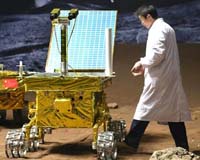 Four Chinese Lunar Landers Mooted
Sydney, Australia (SPX) Oct 06, 2010 For years, the official line on China's robot lunar program was a simple case of 1-2-3. There would be an orbiter (Chang'e 1) followed by a lander bearing a rover (Chang'e 2), and finally, a robot lander with a sample return rocket (Chang'e 3). Prior to late 2007, that was the plan regularly published in Chinese media sources. Shortly before the launch of Chang'e 1 in 2007, China's first l ... read more |
|
|
| The content herein, unless otherwise known to be public domain, are Copyright 1995-2010 - SpaceDaily. AFP and UPI Wire Stories are copyright Agence France-Presse and United Press International. ESA Portal Reports are copyright European Space Agency. All NASA sourced material is public domain. Additional copyrights may apply in whole or part to other bona fide parties. Advertising does not imply endorsement,agreement or approval of any opinions, statements or information provided by SpaceDaily on any Web page published or hosted by SpaceDaily. Privacy Statement |


 del.icio.us
 Digg
Digg Reddit
 YahooMyWeb
 Google
 Facebook


