
 |
 |
 |
 |
 |
 |
 |
 |
 |

 |

Washington (AFP) March 30, 2011 NASA celebrated Wednesday hundreds of stunning photographs from the Mercury MESSENGER probe as it began a year-long mission to orbit and map the solar system's mysterious innermost planet. After more than six and a half years and a 4.9-billion-mile (7.9-billion-kilometer) journey, the spacecraft -- which stands for MErcury Surface, Space ENvironment, GEochemistry, and Ranging -- finally entered the planet's orbit on March 17. On Tuesday, it began unlocking the secrets of a planet where temperatures reach a mind-boggling 800 degrees Fahrenheit (427 degrees Celsius) during the day but plummet to minus 150 degrees (minus 100 degrees Celsius) at night. "Early this morning, at 5:20 am EDT (0920 GMT), MESSENGER captured this historic image of Mercury," NASA said. "This image is the first ever obtained from a spacecraft in orbit about the solar system's innermost planet." The upper part of the first image showed an unusual, dark-rayed crater called Debussy, while the lower part revealed a portion of Mercury near its south pole that has never before been witnessed by spacecraft, according to NASA. The spacecraft snapped 363 images over the next six hours and released more on Wednesday in conjunction with an expert press conference to discuss the findings. "The entire MESSENGER team is thrilled that spacecraft and instrument checkout has been proceeding according to plan," said mission spokesman Sean Solomon of the Carnegie Institution for Science in Washington. "The first images from orbit and the first measurements from MESSENGER's other payload instruments are only the opening trickle of the flood of new information that we can expect over the coming year. The orbital exploration of the solar system's innermost planet has begun." NASA scientists aim to combine data from two earlier fly-bys and from Mariner 10, a spacecraft that made three passes of Mercury in 1974 and 1975, to map out the crater-filled surface of the planet. MESSENGER will begin continuous mapping on April 4, orbiting the planet every 12 hours at a minimum altitude of 124 miles (200 kilometers). Mercury is the closest planet to the sun, and because of the high risks of its proximity -- the sun's enormous gravitational pull and massively high levels of radiation -- it is one of the most mysterious bodies in the solar system, even though it is relatively close to Earth. Earlier visits have shown scientists that enormous volcanic eruptions produced many of its expansive plains, littered with meteor craters, and that its magnetic field appears to be actively generated in a molten iron core. MESSENGER, a 1,067-pound (485-kilogram) robotic probe, was launched in August 2010, making one flyby of the Earth, two of Venus and three of Mercury, the smallest of the eight planets, before entering its new orbit.
Share This Article With Planet Earth
Related Links News Flash at Mercury Mars News and Information at MarsDaily.com Lunar Dreams and more

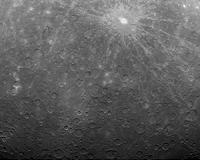 NASA releases picture of Mercury's surface
Washington (AFP) March 29, 2011 NASA on Tuesday released the first picture taken of Mercury's surface by the US space agency's orbiting Messenger craft. "Early this morning, at 5:20 am EDT (0920 GMT), Messenger captured this historic image of Mercury," NASA said. "This image is the first ever obtained from a spacecraft in orbit about the solar system's innermost planet." The spacecraft snapped 363 images over the n ... read more |
|
|
| The content herein, unless otherwise known to be public domain, are Copyright 1995-2010 - SpaceDaily. AFP and UPI Wire Stories are copyright Agence France-Presse and United Press International. ESA Portal Reports are copyright European Space Agency. All NASA sourced material is public domain. Additional copyrights may apply in whole or part to other bona fide parties. Advertising does not imply endorsement,agreement or approval of any opinions, statements or information provided by SpaceDaily on any Web page published or hosted by SpaceDaily. Privacy Statement |


 del.icio.us
 Digg
Digg Reddit
 YahooMyWeb
 Google
 Facebook


