
 |
 |
 |
 |
 |
 |
 |
 |
 |

 |
Making Digital Maps More Current And Accurate
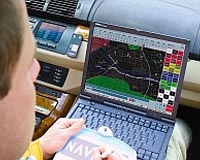
Paris, France (SPX) Feb 10, 2009 European researchers have designed an innovative new system to help keep motorists on the right track by constantly updating their digital maps and fixing anomalies and errors. Now the partners are mapping the best route to market. The 'oddly enough' sections of newspapers regularly feature amusing stories of GPS mayhem. For instance, one lorry driver in Poland had such confidence in his positioning device that he ignored several signs warning that a road had been closed to make way for an artificial reservoir and drove straight into the lake! In addition to providing a cautionary tale about investing too much faith in technology, this amusing anecdote highlights a more mundane and daily challenge: how to reflect the constantly shifting topography of Europe's road network. A large number of digital maps used by onboard GPS navigation systems are stored on DVDs or hard disks, with periodic updates only available on replacement disks. In addition, advanced driver assistance systems (ADAS) - such as adaptive cruise control (ACC) and lane-keeping systems (LKS) - are beginning to make more extensive use of digital maps. Given the safety dimension of ADAS applications, it is crucial that digital maps are highly accurate. Some interactive solutions have made it to market. One example is the EU-backed ActMAP project which developed mechanisms for online, incremental updates of digital map databases using wireless technology. The system helps to shorten the time span between updates significantly. Nevertheless, there is still room for improvement in terms of detecting map errors, changes in the real world, or monitoring highly dynamic events like local warnings automatically. Addressing these ever-changing realities requires a radical rethink of the applied methodology.
Ground-level input If anomalies found by road users could be automatically sent to the supplier, this could be used as a valuable supplementary source of information to iron out irregularities in maps and beam them back to the users. This bottom-up approach is the basic premise of FeedMAP, which has been designed to work in a loop with ActMAP. This means that, when the reality on the ground does not correspond with the digital map in the system, these so-called map deviations are automatically compiled into a map deviation report which is picked up by roadside sensors and relayed back to the supplier. The driver can also report anomalies (s)he encounters manually. "Of course, FeedMAP will obviously not act as an unconditional map update generator. The last verification will always remain to be done by the map centres using their other sources of information," notes Maxime Flament of ERTICO - ITS Europe, a multi-stakeholder organisation pursuing the development and deployment of intelligent transport systems and services. FeedMAP's versatility and potential for fine-tuning means that it not only can help keep maps up to date, but it can also be used in numerous ADAS applications, including adaptive speed recommendations which advise drivers about speed limits on the road ahead, and speed deviation detection which updates recommended speeds based on feedback from actual driver behaviour. FeedMAP can also be integrated into fuel-saving applications, which will be good for the environment and good for motorists' wallets as well.
Mapping the road to market "Based on already existing business models, the FeedMAP concept can be brought to market," concludes Bengt Thomas of NAVIGON, a partner in the project. "The clear benefit for map suppliers is the availability of a constant stream of deviation reports to improve their map quality. As the improvements will be shared with all customers, it will result, in the longer run, in better map products for the whole market." The FeedMAP partners considered three possible business models. The most promising one, which they believe is worth pursuing, focuses on bundling FeedMAP with the other services already offered by car manufacturers, while the actual management of the data and updates would be carried out by so-called FeedMAP service centres. "Automotive manufacturers already offer connected services in their vehicles, therefore the basic communication infrastructure is available for sending and receiving map data," says Jan Loewenau of BMW Research and Technology. FeedMAP partners - including Daimler, BMW, Volvo Trucks and FIAT's research centre - are so positive about the results of the project that they have decided to run with it by integrating it into the ActMAP system. "The complete FeedMAP/ActMAP loop of map data is the next cornerstone for map-based applications, such as navigation and ADAS safety," concludes Flament. FeedMAP was funded by the ICT strand of the EU's Sixth Framework Programme for research. Share This Article With Planet Earth
Related Links ICT Results GPS Applications, Technology and Suppliers
 ESRI's New ArcGIS API For Microsoft Silverlight
 Redlands CA (SPX) Feb 10, 2009
The beta release of the ArcGIS API for Microsoft Silverlight will coincide with the 2009 ESRI Developer Summit in Palm Springs, California, to be held March 23-26. This new API allows application developers to integrate ArcGIS Server and Microsoft Virtual Earth services and capabilities in a Silverlight application. |
|
|

| The content herein, unless otherwise known to be public domain, are Copyright 1995-2007 - SpaceDaily.AFP and UPI Wire Stories are copyright Agence France-Presse and United Press International. ESA Portal Reports are copyright European Space Agency. All NASA sourced material is public domain. Additional copyrights may apply in whole or part to other bona fide parties. Advertising does not imply endorsement,agreement or approval of any opinions, statements or information provided by SpaceDaily on any Web page published or hosted by SpaceDaily. Privacy Statement |
 del.icio.us
 Digg
Digg Reddit
 YahooMyWeb
 Google
 Facebook