
 |
 |
 |
 |
 |
 |
 |
 |
 |

 |
Malaria Immunity Trigger Found For Multiple Mosquito Species
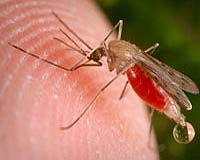
Baltimore MD (SPX) Mar 14, 2009 Researchers at the Johns Hopkins Bloomberg School of Public Health have for the first time identified a molecular pathway that triggers an immune response in multiple mosquito species capable of stopping the development of Plasmodium falciparum-the parasite that causes malaria in humans. By silencing the gene, caspar, the researchers were able to block the development of the malaria-causing parasite in Anopheles gambiae, A. stephensi and A. albimanus mosquitoes-three mosquito species that spread malaria in Africa, Asia and the Americas. Their findings were published March 13 in PLoS Pathogens. According to the study, the transcription factor Rel 2 is a key molecule involved in regulating several potent anti-Plasmodium defense genes that attack the parasite in the mosquito gut. Rel 2 is activated by the immune deficiency pathway (Imd) which, in turn, is negatively regulated by the caspar gene; when caspar is silenced the Rel 2 is activated. The researchers found that silencing of the caspar gene through the manipulation of gene expression resulted in mosquitoes that successfully blocked the development of Plasmodium falciparum in the gut tissue. Silencing the gene known as cactus, which is part of another pathway called Toll, was shown to have similar effect in controlling the development of Plasmodium berghei, which causes malaria in rodents. "When a mosquito is feeding on malaria-infected blood, the parasite will be recognized by the mosquito's immune system through receptors that then start the immune response. In the wild, this response is believed to occur too late to mount an efficient immune defense that would kill all parasites. At least a few Plasmodia will successfully develop inside the mosquito and enable transmission of malaria," explained George Dimopoulos, PhD, senior author of the study and associate professor at the Johns Hopkins Malaria Research Institute. "In the lab we activated this immune response in advance of infection, giving the mosquito a head start in defeating the invading parasite." Dimopoulos and his colleagues Lindsey Graver and Yuemei Dong also found that Rel 2 activation did not affect the survival and egg laying fitness of the modified mosquitoes. "This came as a pleasant surprise since it essentially means that we one day could spread this trait in natural mosquito populations using genetic modification. Furthermore, by activating Rel 2, the genetically modified mosquitoes will attack the malaria parasite with several independent immune factors, and this will make it very difficult for Plasmodium to develop resistance," said Dimopoulos. Malaria kills over one million people worldwide each year. "Caspar controls resistance to Plasmodium falciparum in diverse Anopheline species" was written by Lindsey S. Garver, Yuemei Dong and George Dimopoulos. Funding was provided by National Institutes of Health, the National Science Foundation and the Johns Hopkins Malaria Research Institute. Share This Article With Planet Earth
Related Links Johns Hopkins Bloomberg School of Public Health Epidemics on Earth - Bird Flu, HIV/AIDS, Ebola
 Hong Kong bird tests positive for H5N1
 Hong Kong (AFP) March 12, 2009
Hong Kong authorities said Thursday that a dead chicken found in the territory had tested positive for the deadly H5N1 strain of the bird flu virus. |
|
|

| The content herein, unless otherwise known to be public domain, are Copyright 1995-2007 - SpaceDaily.AFP and UPI Wire Stories are copyright Agence France-Presse and United Press International. ESA Portal Reports are copyright European Space Agency. All NASA sourced material is public domain. Additional copyrights may apply in whole or part to other bona fide parties. Advertising does not imply endorsement,agreement or approval of any opinions, statements or information provided by SpaceDaily on any Web page published or hosted by SpaceDaily. Privacy Statement |
 del.icio.us
 Digg
Digg Reddit
 YahooMyWeb
 Google
 Facebook