
 |
 |
 |
 |
 |
 |
 |
 |
 |

 |
Manufacturing Inefficiency
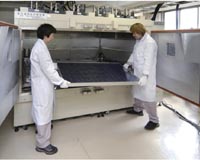
Boston MA (SPX) Mar 31, 2009 Modern manufacturing methods are spectacularly inefficient in their use of energy and materials, according to a detailed MIT analysis of the energy use of 20 major manufacturing processes. Overall, new manufacturing systems are anywhere from 1,000 to one million times bigger consumers of energy, per pound of output, than more traditional industries. In short, pound for pound, making microchips uses up orders of magnitude more energy than making manhole covers. At first glance, it may seem strange to make comparisons between such widely disparate processes as metal casting and chip making. But Professor Timothy Gutowski of MIT's Department of Mechanical Engineering, who led the analysis, explains that such a broad comparison of energy efficiency is an essential first step toward optimizing these newer manufacturing methods as they gear up for ever-larger production. "The seemingly extravagant use of materials and energy resources by many newer manufacturing processes is alarming and needs to be addressed alongside claims of improved sustainability from products manufactured by these means," Gutowksi and his colleagues say in their conclusion to the study, which was recently published in the journal Environmental Science and Technology (ES and T). Gutowksi notes that manufacturers have traditionally been more concerned about factors like price, quality, or cycle time, and not as concerned over how much energy their manufacturing processes use. This latter issue will become more important, however, as the new industries scale up - especially if energy prices rise again or if a carbon tax is adopted, he says. Solar panels are a good example. Their production, which uses some of the same manufacturing processes as microchips but on a large scale, is escalating dramatically. The inherent inefficiency of current solar panel manufacturing methods could drastically reduce the technology's lifecycle energy balance - that is, the ratio of the energy the panel would produce over its useful lifetime to the energy required to manufacture it. The new study is just "the first step in doing something about it," Gutowski says - understanding which processes are most inefficient and need further research to develop less energy-intensive alternatives. For example, many of the newer processes involve vapor-phase processing (such as sputtering, in which a material is vaporized in a vacuum chamber so that it deposits a coating on an exposed surface in that chamber), which is usually much less efficient than liquid phase (such as depositing a coating from a liquid solution), but liquid processing alternatives might be developed. The study covered everything "from soup to nuts" in terms of standard industrial methods, Gutowski says, "from heavy-duty old fashioned industries like a cast-iron foundry, all the way up to semiconductors and nanomaterials." It includes injection molding, sputtering, carbon nanofiber production and dry etching, along with more traditional machining, milling, drilling and melting. There were some boundaries on the processes studied, however: The researchers did not analyze production of pharmaceuticals or petroleum, and they only looked primarily at processes where electricity was the primary energy source. The figures the team derived are actually conservative, Gutowski says, because they did not include some significant energy costs such as the energy required to make the materials themselves or the energy required to maintain the environment of the plant (such as air conditioning and filtration for clean rooms used in semiconductor processing). "All these things would make [the energy costs] worse," he says. The bottom line is that "new processes are huge users of materials and energy," he says. Because some of these processes are so new, "they will be optimized and improved over time," he says. But as things stand now, over the last several decades as traditional processes such as machining and casting have increasingly given way to newer ones for the production of semiconductors, MEMS and nano-materials and devices, for a given quantity of output "we have increased our energy and materials consumption by three to six orders of magnitude." One message from the study is that "claims that these technologies are going to save us in some way need closer scrutiny. There's a significant energy cost involved here," he says. And another is that "each of these processes could be improved," and using the analytical tools developed by the MIT team for this study would be a useful first step in such a detailed analysis. In addition to Gutowski, the study was done by current and former MIT mechanical engineering students Matthew Branham, Jeffrey Dahmus, Alissa Jones and Alexandre Thiriez, and Dusan Sekulic, professor of mechanical engineering at the University of Kentucky. It was funded by the National Science Foundation. Share This Article With Planet Earth
Related Links MIT All About Solar Energy at SolarDaily.com
 Team California Begins Construction On 2009 Solar Decathlon House
 Santa Clara CA (SPX) Mar 31, 2009
Tool belts and hard hats have replaced the backpacks and the laptops of some students at Santa Clara University and California College of Arts in San Francisco. |
|
|

| The content herein, unless otherwise known to be public domain, are Copyright 1995-2007 - SpaceDaily.AFP and UPI Wire Stories are copyright Agence France-Presse and United Press International. ESA Portal Reports are copyright European Space Agency. All NASA sourced material is public domain. Additional copyrights may apply in whole or part to other bona fide parties. Advertising does not imply endorsement,agreement or approval of any opinions, statements or information provided by SpaceDaily on any Web page published or hosted by SpaceDaily. Privacy Statement |
 del.icio.us
 Digg
Digg Reddit
 YahooMyWeb
 Google
 Facebook