
 |
 |
 |
 |
 |
 |
 |
 |
 |

 |
Mars Express Observes Aurorae On The Red Planet
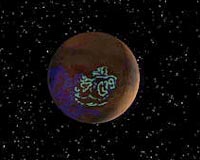
Paris, France (SPX) Nov 24, 2008 Scientists using ESA's Mars Express have produced the first crude map of aurorae on Mars. These displays of ultraviolet light appear to be located close to the residual magnetic fields generated by Mars's crustal rocks. They highlight a number of mysteries about the way Mars interacts with electrically charged particles originating from the Sun. The aurorae on Mars were discovered in 2004 using the SPICAM ultraviolet and infrared atmospheric spectrometer on board Mars Express. They are a powerful tool with which scientists can investigate the composition and structure of the Red Planet's atmosphere. Now Francois Leblanc, from the Service d'Aeronomie, IPSL/CNRS, France and colleagues have announced the results of coordinated observation campaigns using SPICAM, the MARSIS sub-surface sounding radar altimeter's radar, and the energetic neutral atoms analyser, ASPERA's electron spectrometer on Mars Express. They have observed nine new auroral emission events, which have allowed them to make the first crude map of auroral activity on Mars. They see that the aurorae seem to be located near regions where the martian magnetic field is the strongest. MARSIS had previously observed higher-than-expected electrons in similar regions. This suggests, although it does not prove, that the magnetic fields help to create the aurorae. On Earth, aurorae are more commonly known as the northern and southern lights. They are confined to the polar regions and shine brightly at visible as well as ultraviolet wavelengths. The existence of similar aurorae is well known on the giant planets of the Solar System. They occur wherever a planet's magnetic field channels electrically charged particles into the atmosphere. In all of these planets, the magnetic fields are large-scale structures generated deep in the interior of the planet. Mars lacks such a large-scale internal mechanism. Instead, it just generates small pockets of magnetism where areas of rocks in the crust of Mars are themselves magnetic. This results in many magnetic pole-type regions all over Mars. The aurorae are caused by charged particles, in this case most probably electrons, colliding with molecules in the atmosphere. The electrons almost certainly come from the Sun, which constantly blows out electrically charged particles into space. Known as the solar wind, this constant stream of particles provides the source of electrons to generate the aurorae, as suggested by MARSIS and ASPERA. But how the electrons are accelerated to sufficiently high energies to spark aurorae on Mars remains a mystery. "It may be that magnetic fields on Mars connect with the solar wind, providing a road for the electrons to travel along," says Leblanc. Any future astronauts expecting a spectacular light show, similar to aurorae on Earth, may be in for a disappointment. "We're not sure whether the aurorae will be bright enough to be observed at visible wavelengths," says Leblanc. This is because the molecules responsible for the visible light show on Earth - molecular and atomic oxygen and molecular nitrogen - are not abundant enough in the martian atmosphere. SPICAM is designed to work at ultraviolet wavelengths and cannot see whether visible light is being emitted as well. Nevertheless, there is plenty of work for the scientists to do. "There's now a large domain of physics that we have to explore in order to understand the aurorae on Mars. Thanks to Mars Express we have a lot of very good measurements to work with," says Leblanc. Share This Article With Planet Earth
Related Links Mars Express Mars News and Information at MarsDaily.com Lunar Dreams and more
 Mars Express Acquires Sharpest Images Of Martian Moon Phobos
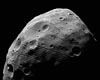 Paris, France (ESA) Jul 31, 2008
Mars Express closed in on the intriguing martian moon Phobos at 6:49 CEST on 23 July, flying past at 3 km/s, only 93 km from the moon. The ESA spacecraft's fly-bys of the moon have returned its most detailed full-disc images ever, also in 3-D, using the High Resolution Stereo Camera on board. |
|
|

| The content herein, unless otherwise known to be public domain, are Copyright 1995-2007 - SpaceDaily.AFP and UPI Wire Stories are copyright Agence France-Presse and United Press International. ESA Portal Reports are copyright European Space Agency. All NASA sourced material is public domain. Additional copyrights may apply in whole or part to other bona fide parties. Advertising does not imply endorsement,agreement or approval of any opinions, statements or information provided by SpaceDaily on any Web page published or hosted by SpaceDaily. Privacy Statement |
 del.icio.us
 Digg
Digg Reddit
 YahooMyWeb
 Google
 Facebook