|
 |
 |
 |
 |
 |
 |
 |
 |

 |
Mars Rover Laser Tool Ready For Testing
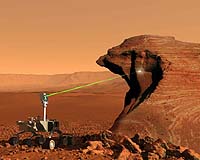
Los Alamos NM (SPX) Jun 22, 2007 Mars mission Job One: Get there. Job Two: Find rocks and zap them with your laser tool. Now learn the nature of the debris by spectrographically analyzing the ensuing dust and fragments. It's every kid's dream, vaporizing pebbles on other planets, and thanks to a team at Los Alamos National Laboratory, it's going to happen. When the JPL-NASA Mars Science Laboratory rover launches in 2009, it will carry this combination laser-telescope unit and enable the gadget-packed rover to know a great deal about rocks in its general vicinity. The ChemCam package includes a mast unit, projecting above the rover with a laser and telescope, and a body unit, the brains of the beast, with three spectrographs and the instrument controls. The engineering model of ChemCam's mast unit, fresh from Thales Laser and Centre d'Etude Spatiale des Rayonnements (CESR) in France, is undergoing rigorous testing at Los Alamos. A team of six French experts is checking out the mast unit this week and making sure that it is properly connected with the rest of the instrument, built at Los Alamos. This fall the entire instrument will be shipped to the Jet Propulsion Laboratory, where more tests will take place and additional equipment will be added. "We're pioneering a new technique for exploring Mars. It's really exciting to see the whole thing come together," said Roger Wiens, project lead and a Los Alamos scientist. The ChemCam laser emits very short pulses of 7 nanoseconds, through a small telescope that focuses the beam to a spot where the power density exceeds 10 megawatts per square millimeter, producing a plasma of vaporized material from the target rock. The unit operates on targets at distances between 4 and 30 feet. The unit also contains a camera to take extreme close-up pictures of the targets to show geologic context for each sample. The telescope and electronics were built by CESR, a research institute in Toulouse, France. The mast unit was funded by CNES, the French Space Agency. The full ChemCam flight model will be delivered to JPL in Spring of 2008. Scheduled to launch in the fall of 2009, Mars Science Laboratory is part of NASA's Mars Exploration Program, a long-term effort of robotic exploration of the red planet. Mars Science Laboratory is a rover that will assess whether Mars ever was, or is still today, an environment able to support microbial life. In other words, its mission is to determine the planet's habitability. Community Email This Article Comment On This Article Related Links Mars Science Lab at NASA Los Alamos National Laboratory Mars News and Information at MarsDaily.com Lunar Dreams and more
 UN Warns Aging Populations Will Require New Approaches
 United Nations (UPI) June 19, 2007
While the United Nations says the world's aging population will impact both developed and developing countries, adverse effects may be countered by policy initiatives to harness the change in demographics, such as having more women and seniors in the work force. |
|
|
| The content herein, unless otherwise known to be public domain, are Copyright Space.TV Corporation. AFP and UPI Wire Stories are copyright Agence France-Presse and United Press International. ESA Portal Reports are copyright European Space Agency. All NASA sourced material is public domain. Additional copyrights may apply in whole or part to other bona fide parties. Advertising does not imply endorsement, agreement or approval of any opinions, statements or information provided by Space.TV Corp on any Web page published or hosted by Space.TV Corp. Privacy Statement |