|
 |
 |
 |
 |
 |
 |
 |

| . |  |
. |

|
|
 |
  by Staff Writers Socorro NM (SPX) Apr 19, 2013
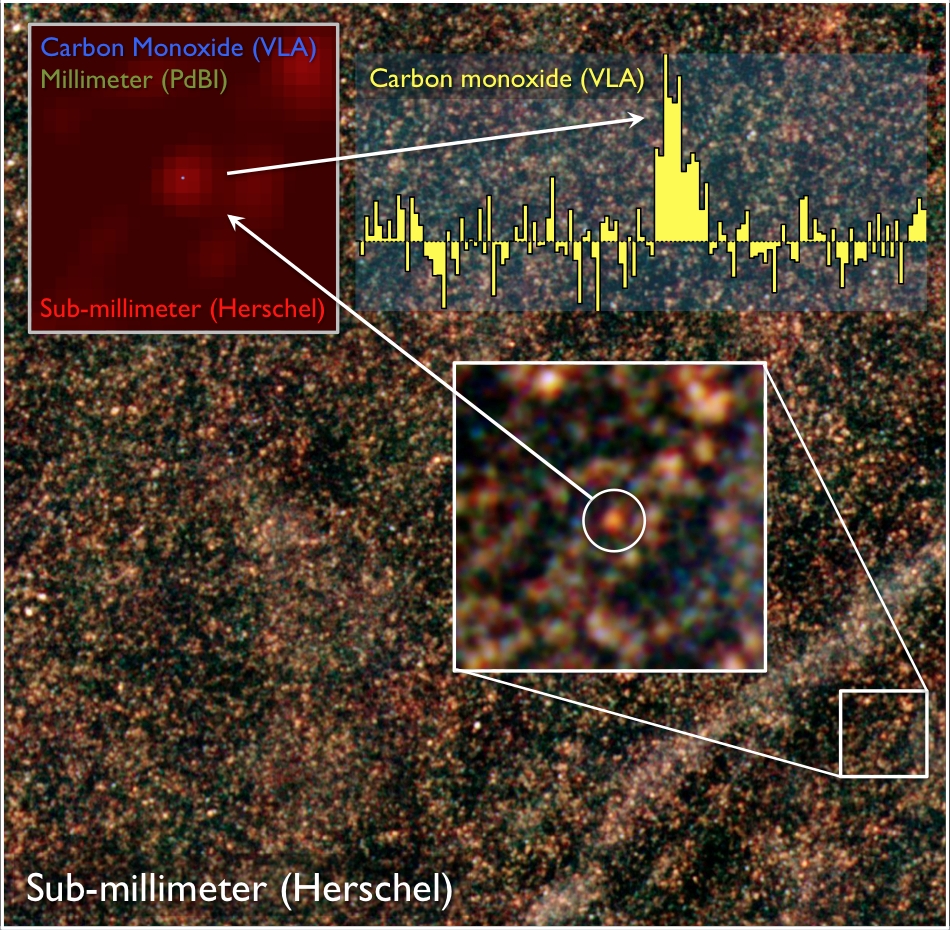
Astronomers using a world-wide collection of telescopes have discovered the most prolific star factory in the Universe, surprisingly in a galaxy so distant that they see as it was when the Universe was only six percent of its current age. The galaxy, dubbed HFLS3, 12.8 billion light-years from Earth, is producing the equivalent of nearly 3,000 Suns per year, a rate more than 2,000 times that of our own Milky Way. The galaxy is massive, with a huge reservoir of gas from which to form new stars. "This is the most detailed look into the physical properties of such a distant galaxy ever made," said Dominik Riechers, of Cornell University. "Getting detailed information on galaxies like this is vitally important to understanding how galaxies, as well as groups and clusters of galaxies, formed in the early Universe," he added. To accurately determine the galaxy's distance and characteristics required observations with 12 international telescope facilities, including both orbiting and ground-based telescopes. The telescopes ranged from visible-light telescopes, to instruments working at infrared, millimeter-wave, and radio wavelengths. The National Science Foundation's Karl G. Jansky Very Large Array (VLA) provided information about cold molecular gas from which new stars are being formed and the radio waves emitted by the remnants of deceased, short-lived, very massive stars. The scientists found that the galaxy has a mass of stars nearly 40 billion times the mass of the Sun, and gas and dust totalling more than 100 billion times the mass of the Sun, all surrounded by enough mysterious dark matter to eventually build an entire cluster of galaxies. "This galaxy is proof that very intense bursts of star formation existed only 880 million years after the Big Bang," Riechers said. "We've gotten a valuable look at a very important epoch in the development of the first galaxies," he added. The Universe currently is about 13.7 billion years old. "Key information about the massive amount of gas in this galaxy came from the VLA observations of radio emission from Carbon Monoxide," said Chris Carilli, Chief Scientist of the National Radio Astronomy Observatory, who was not part of the research team. "The techniques used by this team, along with improved technical capabilities available now and coming in the future, will allow the study of more such galaxies, and provide a much better understanding of how the first galaxies formed during the Universe's youth," Carilli added. "We anticipate learning more about such galaxies using both the VLA and the Atacama Large Millimeter/submillimeter Array (ALMA)," Riechers said. "The VLA can give us information about the cold gas and radio emission in these galaxies, while ALMA can tell us about the warmer gas and dust," he added. In addition to the VLA, the astronomers used the Herschel Space Observatory, the Combined Array for Research in Millimeter-wave Astronomy, the Caltech Submillimeter Observatory, the Plateau de Bure Interferometer, the Submillimeter Array, the IRAM 30-meter Telescope, the William Herschel Telescope and Gran Telescopio Canarias, the Keck Observatory, the Wide-Field Infrared Survey Explorer, and the Spitzer Space Telescope. The large research team included astronomers from Europe, Japan, and the U.S. The scientists reported their findings in the journal Nature.
Related Links National Radio Astronomy Observatory Stellar Chemistry, The Universe And All Within It
|
|
|
| The content herein, unless otherwise known to be public domain, are Copyright 1995-2012 - Space Media Network. AFP, UPI and IANS news wire stories are copyright Agence France-Presse, United Press International and Indo-Asia News Service. ESA Portal Reports are copyright European Space Agency. All NASA sourced material is public domain. Additional copyrights may apply in whole or part to other bona fide parties. Advertising does not imply endorsement,agreement or approval of any opinions, statements or information provided by Space Media Network on any Web page published or hosted by Space Media Network. Privacy Statement |

 del.icio.us
 Digg
Digg Reddit
 Google