|
 |
 |
 |
 |
 |
 |
 |

| . |  |
. |

|
|
. |

 by Staff Writers Moffett Field CA (SPX) Jun 02, 2011
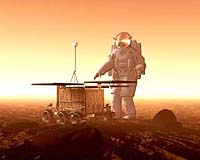
What would it take to make a manned mission to Mars a reality? A team of aerospace and textile engineering students from North Carolina State University believe part of the solution may lie in advanced textile materials. The students joined forces to tackle life-support challenges that the aerospace industry has been grappling with for decades. "One of the big issues, in terms of a manned mission to Mars, is creating living quarters that would protect astronauts from the elements - from radiation to meteorites," says textile engineering student Brent Carter. "Currently, NASA uses solid materials like aluminum, fiberglass and carbon fibers, which while effective, are large, bulky and difficult to pack within a spacecraft." Using advanced textile materials, which are flexible and can be treated with various coatings, students designed a 1,900-square-foot inflatable living space that could comfortably house four to six astronauts. This living space is made by layering radiation-shielding materials like Demron (used in the safety suits for nuclear workers cleaning up Japan's Fukushima plant) with a gas-tight material made from a polyurethane substrate to hold in air, as well as gold-metalicized film that reflects UV rays - among others. The space is dome-shaped, which will allow those pesky meteors, prone to showering down on the red planet, to bounce off the astronauts' home away from home without causing significant damage. "We're using novel applications of high-tech textile technology and applying them to aerospace problems," explains Alex Ray, a textile engineering student and team member. "Being able to work with classmates in aeronautical engineering allowed us to combine our knowledge from both disciplines to really think through some original solutions." Students also tackled another major issue preventing a manned mission to Mars - water supply. Currently, astronauts utilize something called a Sabatier reactor to produce water while in space. The Sabatier process involves the reaction of carbon dioxide and hydrogen, with the presence of nickel, at extremely high temperatures and pressure to produce water and methane. "We wanted to find a way to improve the current Sabatier reactor so we could still take advantage of the large quantities of carbon dioxide available on Mars, and the fact that it is relatively easy to bring large quantities of hydrogen on the spacecraft, since it is such a lightweight element," says recent aerospace engineering graduate Mark Kaufman, who was also on the design team. Current Sabatier reactors, Kaufman explains, are long, heavy tubes filled with nickel pellets - not ideal for bringing on a spacecraft. The student groups worked to develop a fiber material to which they applied nickel nanoparticles to create the same reaction without all the weight and volume. They believe their redesigned Sabatier reactor would be more feasible to carry along on a future space shuttle. In addition to Carter, Ray and Kaufman, the team also included Kris Tesh, Grant Gilliam, Kasey Orrell, Daniel Page and Zack Hester. Textile engineering professor and former aerospace engineer, Dr. Warren Jasper, served as the faculty sponsor. The team also received valuable feedback from Fred Smith, an advanced life support systems engineer with NASA. Jasper and the student team will present their project at the NASA-sponsored Revolutionary Aerospace Systems Concepts Academic Linkage (RASC-AL) competition, held June 6-8 in Cocoa Beach, Fla. The project will be judged by NASA and industry experts against other undergraduate groups from across the country. RASC-AL was formed to provide university-level engineering students the opportunity to design projects based on NASA engineering challenges, as well as offer NASA access to new research and design projects by students. Human explorers on Mars will play a role in the future of astrobiology science. Not only will they themselves help scientists understand how living organisms adapt to life beyond the Earth, but they will also perform key scientific experiments that will answer questions about the potential for past or present life on the red planet.
|
. |
|
| The content herein, unless otherwise known to be public domain, are Copyright 1995-2011 - Space Media Network. AFP and UPI Wire Stories are copyright Agence France-Presse and United Press International. ESA Portal Reports are copyright European Space Agency. All NASA sourced material is public domain. Additional copyrights may apply in whole or part to other bona fide parties. Advertising does not imply endorsement,agreement or approval of any opinions, statements or information provided by Space Media Network on any Web page published or hosted by Space Media Network. Privacy Statement |

 del.icio.us
 Digg
Digg Reddit
 Google