
 |
 |
 |
 |
 |
 |
 |
 |
 |

 |

Berlin, Germany (SPX) Mar 21, 2011 Early on 18 March 2011, a spacecraft swung into orbit around Mercury for the first time: NASA's MESSENGER began orbiting the planet at 01:45 CET. The mission carries scientific instruments designed to map Mercury and analyse the structure and composition of its surface. Scientists at the German Aerospace Center (Deutsches Zentrum fur Luft- und Raumfahrt; DLR) will analyse the data received from three of the instruments on MESSENGER. As far as the planets of the Solar System are concerned, Mercury is still quite a mystery. The smallest of the terrestrial planets, it has an unusually high density. Its interior consists of an iron core surrounded by a thin rocky mantle and crust. How Mercury came to lose its lighter elements and the nature of its magnetic field is still a mystery. Researchers have suggested that that the deep floors and walls of craters near its poles harbour frozen deposits of ice, but this has yet to be confirmed. "Mercury is a very extreme and unusual planet," says Tilman Spohn, head of the DLR Institute of Planetary Research. "We would like to understand why on the inside it's quite Earth-like, but on the outside appears to be an old, almost inactive moon."
Observing Mercury from orbit for the first time The spacecraft burned 600 kilograms of fuel to enter into orbit. "Not just this manoeuvre, but the entire mission ill be an endurance test for the experiments". Seven instruments and one radio wave experiment should help researchers find answers to their questions and obtain a wide variety of measurements of the planet. The Mercury Atmospheric and Surface Composition Spectrometer (MASCS), combines an ultraviolet and visible light spectrometer and an infrared spectrograph. It will provide DLR planetary scientist Jorn Helbert with clues about Mercury's rocky composition. "We have already begun analysing the data that the spectrometer has been sending since its first minute in orbit," says Helbert. DLR researchers have developed new software for the mission to process the data acquired by MASCS as quickly as possible. Helbert, a member of the geology working group for the MESSENGER mission, is trying to recreate a Mercury-like environment in the one-of-a kind Planetary Emissivity Laboratory (PEL) of the DLR Institute of Planetary Research. "We are planning to take measurements of rocks at 430 degrees Celsius, similar to the extreme conditions that prevail on the surface of Mercury," he explains. Helbert can then compare the results obtained in the laboratory with the data from the spectrometer on board MESSENGER: this will allow DLR researchers to draw conclusions about the composition of Mercury's surface.
3D images of the closest planet to the Sun In combination with the Mercury Laser Altimeter (MLA), MDIS will create topographic maps of the surface of Mercury. Large areas have already been recorded in three flybys but the data from orbit will fill in the last remaining gaps on the map of Mercury. More instruments will allow scientists to gain insight on other secrets revolving around Mercury. The X-Ray Spectrometer (XRS) and the Gamma-Ray and Neutron Spectrometer (GRNS) will determine the mineralogical composition of the surface with great accuracy. The Magnetometer (MAG) will analyse Mercury's still poorly understood magnetic field. The Energetic Particle and Plasma Spectrometer (EPPS) will detect charged particles in the magnetosphere and exosphere. As part of the Radio Science (RS) experiment, the velocity and position of MESSENGER will be measured with high precision. The data obtained will help scientists study Mercury's gravitational field.
BepiColombo: another mission to Mercury Another mission to Mercury is already underway: BepiColombo, a joint European Space Agency (ESA) and Japanese Aerospace Exploration Agency (JAXA) mission is scheduled to fly to Mercury in 2014. DLR is also involved in this mission, with the Mercury Radiometer and Thermal Infrared Spectrometer (MERTIS) and the BepiColombo Laser Altimeter (BELA). BepiColombo's main objective is to explore the areas of Mercury that MESSENGER is unable to study in high resolution due to its orbit. "MESSENGER is the pathfinder for this mission and is already delivering the first results," says Spohn. "We have just reached the most exciting part of the MESSENGER mission, flying the spacecraft to just about 200 kilometres above the surface of Mercury."
Share This Article With Planet Earth
Related Links Messenger at APL News Flash at Mercury Mars News and Information at MarsDaily.com Lunar Dreams and more

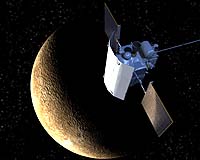 NASA spacecraft is first to orbit Mercury
Washington (AFP) March 17, 2011 A NASA spacecraft began orbiting Mercury Thursday, becoming the first to fly around the solar system's innermost planet, the space agency said. The craft, known as MESSENGER, began the orbit around 9:00 pm (0200 GMT) on a mission to circle the planet for one Earth year in an unprecedented study of the tiny, hot planet. The spacecraft began its journey more than six years ago, traveling t ... read more |
|
|
| The content herein, unless otherwise known to be public domain, are Copyright 1995-2010 - SpaceDaily. AFP and UPI Wire Stories are copyright Agence France-Presse and United Press International. ESA Portal Reports are copyright European Space Agency. All NASA sourced material is public domain. Additional copyrights may apply in whole or part to other bona fide parties. Advertising does not imply endorsement,agreement or approval of any opinions, statements or information provided by SpaceDaily on any Web page published or hosted by SpaceDaily. Privacy Statement |


 del.icio.us
 Digg
Digg Reddit
 YahooMyWeb
 Google
 Facebook


