
 |
 |
 |
 |
 |
 |
 |
 |
 |

 |

for NASA Science News Huntsville AL (SPX) Oct 25, 2010 Astrobiologists searching for life beyond Earth need to know how well life and its building blocks fare in space. To find out, NASA will monitor a miniature "crew" of organic molecules and microbes orbiting Earth for 6 months. "This will be the first mission since the early 1970s to test a life form's mettle outside the protection of Earth's magnetic field," says science team member Wayne Nicholson of NASA's Kennedy Space Center. "The conditions are harsh 'out there' - extreme vacuum and cosmic radiation are tough on life." The shoebox-sized O/OREOS (Organism/ORganic Exposure to Orbital Stresses) satellite will venture outside our planet's magnetic shield twice during each of its polar orbits - as it passes over the poles. Over 6 months, there will be significant cumulative exposure to cosmic radiation. O/OREOS will host two separate experiments simultaneously. In one experiment, called SEVO (Space Environment Viability of Organics), samples of various organic molecules on a rotating wheel outside the satellite will be exposed to solar radiation-the kind of radiation a molecule might experience when it hitches a ride on a comet. There are many interstellar clouds of gas in our galaxy chock-full of carbon-containing compounds. Some of these molecules adhere to dust particles and are swept up in comets. Could comets have express-delivered some of life's precursors to our planet and other worlds? To help answer that question, SEVO will reveal how stable organic compounds are in space and how they're altered. "When our wheel of organic compounds points at the sun, sunlight will pass through the thin film of molecules," explains science team member Richard Quinn of NASA Ames Research Center. "A spectrometer will record the molecules' absorption of ultraviolet and visible light, and a radio will send the data to Earth for analysis. We'll be able to see how the spectra change - and therefore how the compounds themselves change." The second experiment, called SESLO (Space Environment Survivability of Live Organisms), will check to see how microbes hold up to long duration space flight. Four strains of dormant, dried microbes inside the spacecraft will be revived at 1 week, 3 months, and 6 months with a dousing of their favorite medium (food). A three-color LED and detector will monitor the organisms' growth and metabolism by detecting changes in color of a dye that responds to metabolic activity. Astrobiologist Chris McKay also of Ames is not directly associated with the mission, but he eagerly anticipates the results: "We study microbes because, compared to other living things, including us, bacteria are very resilient. They are known to have survived tremendously inhospitable conditions here on Earth." Some microbes have developed a unique survival strategy for enduring extremes. When the going gets tough, they spontaneously replicate their own genetic material and form layers of protective coatings around it, fashioned from their own proteins. The resulting spores are encapsulated and equipped to face extreme temperatures, radiation, and even lack of water, air, and nutrients. "It's as if they form their own tiny space capsules - spores," says McKay. "In fact, we scientists store them as spores." The hardiness of bacteria creates what Nicholson calls "a very sticky wicket" - especially if their "space capsules" are tough enough to withstand the extremes of space. "If we do ever isolate a 'bug' from Mars or anywhere else, we'll have to prove we didn't inadvertently bring a microbial hitchhiker from Earth on our spacecraft, contaminating the extraterrestrial sample," he explains. Neither, he says, do we want to contaminate a pristine alien world with our microbes. "Since the O/OREOS mission length will be [almost as long as] an Earth-to-Mars trip, the results will tell us something about how microorganisms would react on such a voyage. We're looking at some very resilient microbes that could serve as proxies for actual spacecraft contaminants." "The first explorers on Earth simply sailed across the ocean and infected the western hemisphere with all sorts of problems - small pox for example," notes Nicholson. "Now we are taking the time to plan and prepare, with experiments like ours, and we're moving forward cautiously." O/OREOS is tentatively scheduled for launch in November of 2010.
Share This Article With Planet Earth
Related Links Astrobiology at NASA Life Beyond Earth Lands Beyond Beyond - extra solar planets - news and science

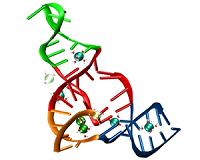 Powerful Supercomputer Peers Into The Origin Of Life
Oak Ridge TN (SPX) Oct 06, 2010 Supercomputer simulations at the Department of Energy's Oak Ridge National Laboratory are helping scientists unravel how nucleic acids could have contributed to the origins of life. A research team led by Jeremy Smith, who directs ORNL's Center for Molecular Biophysics and holds a Governor's Chair at University of Tennessee, used molecular dynamics simulation to probe an organic chemical r ... read more |
|
|
| The content herein, unless otherwise known to be public domain, are Copyright 1995-2010 - SpaceDaily. AFP and UPI Wire Stories are copyright Agence France-Presse and United Press International. ESA Portal Reports are copyright European Space Agency. All NASA sourced material is public domain. Additional copyrights may apply in whole or part to other bona fide parties. Advertising does not imply endorsement,agreement or approval of any opinions, statements or information provided by SpaceDaily on any Web page published or hosted by SpaceDaily. Privacy Statement |


 del.icio.us
 Digg
Digg Reddit
 YahooMyWeb
 Google
 Facebook


