
 |
 |
 |
 |
 |
 |
 |
 |
 |

 |

Madison WI (SPX) Nov 18, 2010 Months of volcanic restlessness preceded the eruptions this spring of Icelandic volcano Eyjafjallajokull, providing insight into what roused it from centuries of slumber. An international team of researchers analyzed geophysical changes in the long-dormant volcano leading up to its eruptions in March and April 2010 that suggest that magma flowing beneath the volcano may have triggered its reawakening. Their study is published in the Nov. 18 issue of the journal Nature. "Several months of unrest preceded the eruptions, with magma moving around downstairs in the plumbing and making noise in the form of earthquakes," says study co-author Kurt Feigl, a professor of geosciences at the University of Wisconsin-Madison. "By monitoring volcanoes, we can understand the processes that drive them to erupt." With funding from a RAPID grant from the U.S. National Science Foundation, Feigl and collaborators from Iceland, Sweden, and the Netherlands used a combination of satellite imaging and GPS surveying to watch the volcano's edifice as it deformed. They found that the volcano swelled for 11 weeks before it began to erupt in March 2010 from one flank. "If you watch a volcano for decades, you can tell when it's getting restless," Feigl says. In late summer 2009, a subtle shift at a GPS station on Eyjafjallajokull's flank prompted the study's lead author, Freysteinn Sigmundsson, and his colleagues to begin monitoring the mountain more closely. Then, in early January 2010, the rate of deformation and the number of earthquakes began to increase. As the deformation and seismic unrest continued, the researchers installed more GPS stations near the mountain. Just a few weeks later, the instruments detected more rapid inflation, indicating that magma was moving upwards through the "plumbing" inside the volcano. By the time the volcano began to erupt on March 20, the volcano's flanks had expanded by more than six inches as magma flowed from deep within the Earth into shallow chambers underneath the mountain. Surprisingly, the rapid deformation stopped as soon as the eruption began. In many cases, volcanoes deflate as magma flows out of shallow chambers during an eruption. Eyjafjallajokull, however, maintained basically the same inflated shape through mid-April, when the first eruption ended. After a two-day pause, the volcano began to erupt again on April 22. This time, the lava broke out through a new conduit under the ice on the summit of the mountain, causing an explosive reaction as water flashed to steam and gas escaped from bubbles in the magma. The resulting "ash" plume rose high into the atmosphere, disrupting air traffic over Europe for weeks and stranding millions of travelers. Why did Eyjafjallajokull erupt when it did? The geologic processes that trigger an actual eruption are not yet well understood, says Feigl. "We're still trying to figure out what wakes up a volcano." To begin to answer this question, the scientists suggest that a magmatic intrusion deep within the volcano may have triggered the eruption, but this hypothesis remains to be tested at other volcanoes. They are also studying the structures inside the volcano, such as magma chambers and intrusive conduits, by extracting information from the sensors installed around Eyjafjallajokull. "The explosiveness of the eruption depends on the type of magma, and the type of magma depends on the depth of its source," Feigl says. "We're a long way from being able to predict eruptions, but if we can visualize the magma as it moves upward inside the volcano, then we'll improve our understanding of the processes driving volcanic activity." Satellite radar images were obtained from TerraSAR-X, a satellite operated by the German Space Agency (DLR). Funding was provided by the National Science Foundation, Icelandic Research Fund, University of Iceland, and the Icelandic government.
Share This Article With Planet Earth
Related Links University of Wisconsin-Madison Bringing Order To A World Of Disasters When the Earth Quakes A world of storm and tempest

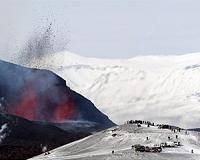 Icelandic volcano: Scientists map anatomy of an eruption
Paris (AFP) Nov 17, 2010 The eruption of Eyjafjoell, the Icelandic volcano which grounded flights across Europe this year, followed a long, threatening warm-up in which the mountain growled and its icy flanks bulged, scientists said on Wednesday. Vulcanologists from the United States, Iceland, Sweden and the Netherlands used satellite images and data from Global Positioning System (GPS) movement monitors to build a ... read more |
|
|
| The content herein, unless otherwise known to be public domain, are Copyright 1995-2010 - SpaceDaily. AFP and UPI Wire Stories are copyright Agence France-Presse and United Press International. ESA Portal Reports are copyright European Space Agency. All NASA sourced material is public domain. Additional copyrights may apply in whole or part to other bona fide parties. Advertising does not imply endorsement,agreement or approval of any opinions, statements or information provided by SpaceDaily on any Web page published or hosted by SpaceDaily. Privacy Statement |


 del.icio.us
 Digg
Digg Reddit
 YahooMyWeb
 Google
 Facebook


