|
 |
 |
 |
 |
 |
 |
 |

| . |  |
. |

|
|
. |

 by Staff Writers Tel Aviv, Israel (SPX) Oct 07, 2011
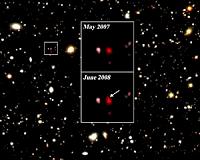
Supernovas - stars in the process of exploding - open a window onto the history of the elements of Earth's periodic table as well as the history of the universe. All of those heavier than oxygen were formed in nuclear reactions that occurred during these explosions. The most ancient explosions, far enough away that their light is reaching us only now, can be difficult to spot. A project spearheaded by Tel Aviv University researchers has uncovered a record-breaking number of supernovas in the Subaru Deep Field, a patch of sky the size of a full moon. Out of the 150 supernovas observed, 12 were among the most distant and ancient ever seen. The discovery sharpens our understanding of the nature of supernovas and their role in element formation, say study leaders Prof. Dan Maoz, Dr. Dovi Poznanski and Or Graur of TAU's Department of Astrophysics at the Raymond and Beverly Sackler School of Physics and Astronomy. These "thermonuclear" supernovas in particular are a major source of iron in the universe. The research, which appears in the Monthly Notices of the Royal Astronomical Society this month, was done in collaboration with teams from a number of Japanese and American institutions, including the University of Tokyo, Kyoto University, the University of California Berkeley, and Lawrence Berkeley National Laboratory.
A key element of the universe By tracking the frequency and types of supernova explosions back through cosmic time, astronomers can reconstruct the universe's history of element creation. In order to observe the 150,000 galaxies of the Subaru Deep Field, the team used the Japanese Subaru Telescope in Hawaii, on the 14,000-foot summit of the extinct Mauna Kea volcano. The telescope's light-collecting power, sharp images, and wide field of view allowed the researchers to overcome the challenge of viewing such distant supernovas. By "staring" with the telescope at the Subaru Deep Field, the faint light of the most distant galaxies and supernovas accumulated over several nights at a time, forming a long and deep exposure of the field. Over the course of observations, the team "caught" the supernovas in the act of exploding, identifying 150 supernovas in all.
Sourcing man's life-blood Scientists have long been aware of the "universal expansion," the fact that galaxies are receding from one another. Observations using Type-Ia supernovas as beacons have shown that the expansion is accelerating, apparently under the influence of a mysterious "dark energy" - the 2011 Nobel Prize in Physics will be awarded to three astronomers for this work. However, the nature of the supernovas themselves is poorly understood. This study improves our understanding by revealing the range of the ages of the stars that explode as Type-Ia supernovas. Eventually, this will enhance their usefulness for studying dark energy and the universal expansion, the researchers explain.
- Stellar Chemistry, The Universe And All Within It
|
. |
|
| The content herein, unless otherwise known to be public domain, are Copyright 1995-2011 - Space Media Network. AFP and UPI Wire Stories are copyright Agence France-Presse and United Press International. ESA Portal Reports are copyright European Space Agency. All NASA sourced material is public domain. Additional copyrights may apply in whole or part to other bona fide parties. Advertising does not imply endorsement,agreement or approval of any opinions, statements or information provided by Space Media Network on any Web page published or hosted by Space Media Network. Privacy Statement |

 del.icio.us
 Digg
Digg Reddit
 Google