|
 |
 |
 |
 |
 |
 |
 |
 |

 |
Most Detailed Map Of Nearby Universe Completed
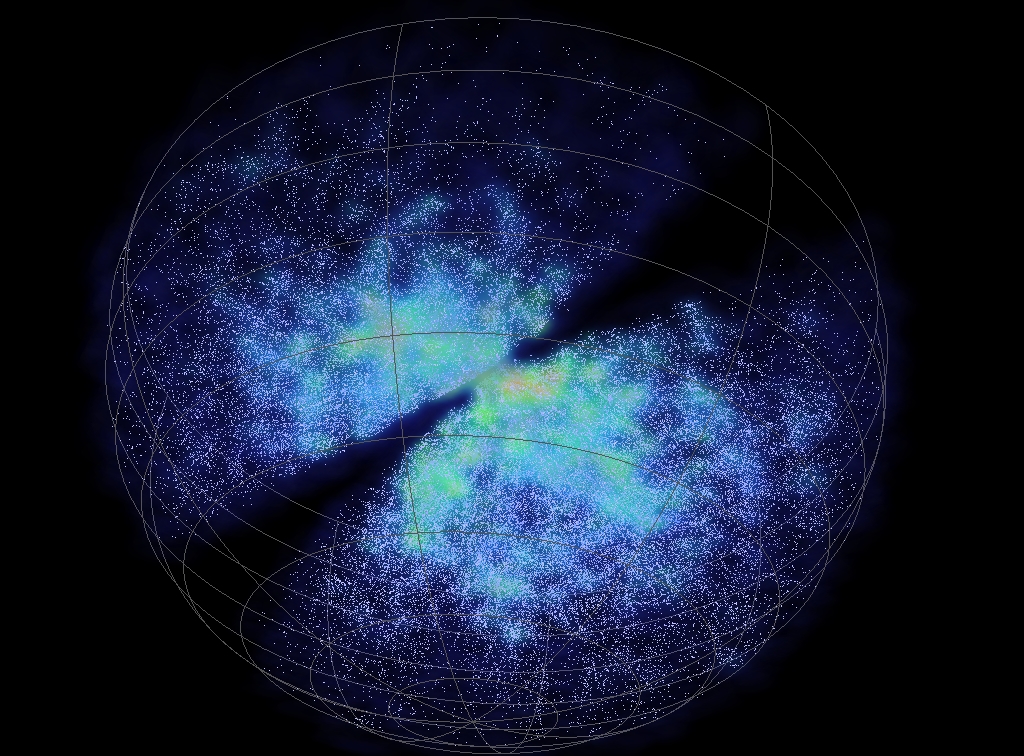
Washington DC (SPX) Apr 07, 2009 Researchers from Australia, the UK and the USA have just completed the most detailed survey of galaxies in the nearby Universe, which will reveal not only where the galaxies are but also where they are heading, how fast, and why. Galaxies are tugged around by each other's gravity. By measuring the galaxies' movements, the researchers can map the gravitational forces at work in the local Universe, and so show how matter, seen and unseen, is distributed. "Light can be obscured, but you can't hide gravity," said Dr. Heath Jones, lead scientist for the Six-Degree Field Galaxy Survey (6dFGS). The 6dFGS was carried out with the 1.2-m UK Schmidt Telescope in eastern Australia, operated by the Anglo-Australian Observatory. Broader and shallower than previous comparable surveys - it covered twice as much as sky as the Sloan Digital Sky Survey - it has recorded the positions of more than 110,000 galaxies over more than 80% of the Southern sky, out to about two thousand million light-years from Earth (a redshift of 0.15). The survey shows strings and clusters of nearby galaxies on large scales in unprecedented detail, and has revealed more than 500 voids� apparently empty areas of space with no galaxies. The special aspect of this survey is that it will let the researchers disentangle two causes of galaxy movements. As well as being pulled on by gravity, galaxies also ride along with the overall expansion of the Universe. For about 10% of their galaxies, the 6dFGS researchers will tease apart these two velocity components: the one associated with the Universe's expansion, and the one representing a galaxy's individual, "peculiar", motion. There have been previous dedicated peculiar-velocity surveys, but 6dFGS will provide more than five times more peculiar velocities that the largest of these surveys. Calculating peculiar velocities is done by comparing the galaxy's distance predicted by its redshift with its distance measured using the internal properties of the galaxy. The technique depends on measuring the width of spectral lines in a galaxy, and doing this accurately needs a high-resolution spectrograph, such as the one purpose-built for this survey. From conception to delivery, the 6dFGS has taken almost a decade. It was made possible by a purpose-built spectrograph and robotic fiber positioner, the Six-Degree Field (6dF) instrument, which allowed 150 spectra to be taken simultaneously. The survey also took advantage of the UK Schmidt Telescope's wide field of view - 5.7 degrees, or 11 times the width of the full Moon - which was key to the survey being able to cover 80% of the Southern sky in a reasonable time. The sample of galaxies was drawn mainly from the 2MASS Extended Source Catalog: that is, they were selected by their infrared light rather than optically selected. Selecting galaxies by their near-infrared (K band) magnitudes avoids bias against galaxies that are currently forming few stars, and instead selects by total stellar mass. Share This Article With Planet Earth
Related Links Six-Degree Field Galaxy Survey (6dFGS) Astronomy News from Skynightly.com
 Enlightenment through darkness in Pyrenees mountains
 Pic Du Midi, France (AFP) April 3, 2009
France aims to set up Europe's first "anti light-pollution reserve" to help preserve the night sky for a historic observatory in the Pyrenees, it was announced here Friday. |
|
|

| The content herein, unless otherwise known to be public domain, are Copyright 1995-2007 - SpaceDaily.AFP and UPI Wire Stories are copyright Agence France-Presse and United Press International. ESA Portal Reports are copyright European Space Agency. All NASA sourced material is public domain. Additional copyrights may apply in whole or part to other bona fide parties. Advertising does not imply endorsement,agreement or approval of any opinions, statements or information provided by SpaceDaily on any Web page published or hosted by SpaceDaily. Privacy Statement |
 del.icio.us
 Digg
Digg Reddit
 YahooMyWeb
 Google
 Facebook