
 |
 |
 |
 |
 |
 |
 |
 |
 |

 |
Mystery Of Missing Hydrogen
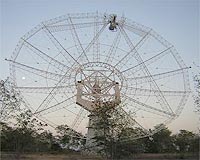
Sydney, Australia (SPX) Nov 26, 2008 Something vital is missing in the far distant reaches of the Universe: hydrogen - the raw material for stars, planets and possible life. The discovery of its apparent absence from distant galaxies by a team of Australian astronomers is puzzling because hydrogen gas is the most common constituent of normal matter in the Universe. If anything, hydrogen was expected to be more abundant so early in the life of the Universe because it had not yet been consumed by the formation of all the stars and galaxies we know today. Dr Steve Curran and colleagues at the University of New South Wales made their observations with the Giant Metrewave Radio Telescope in India, which comprises thirty 45-metre-diameter dishes and is one of the world's most sensitive radio telescopes. The results are to be published in a forthcoming issue of Monthly Notices of the Royal Astronomical Society. By looking at galaxies in which the light has taken over 11.5 billion years to reach us, they found an apparent lack of hydrogen when the Universe was only two billion years old - long before our own Sun and all other stars in the present Universe had formed. Stars form when extremely cold clouds of hydrogen collapse under their own gravity until they become dense enough to ignite nuclear fusion. Over billions of years, this leads the formation of the heavier elements that make up planets, people and other matter. Each galaxy should contain gas masses equivalent to several billion stars, as in the Milky Way. "Since hydrogen gas is consumed by star formation, we may expect more hydrogen gas in the distant, and therefore earlier, Universe as all of the stars we see today have yet to form," Dr Curran says. His group analysed the data from optical telescopes and found that, although apparently dim due to their immense distances, the distant galaxies actually emit vast amounts of energy. This energy is generally believed to result from the friction of the material spiralling at close to the speed of light into the black hole lurking within the heart of each galaxy. These "quasars" are found all over the sky but occur predominantly in the early Universe. "At such distances, only the most optically bright objects are known," Dr Curran says. "The intense radiation from the matter accreting into the black hole in these quasars is extreme and we believe that this radiation is ripping the electrons from the atoms, destroying the hydrogen gas." This would leave the gas as a soup of free subatomic particles known as a "plasma", which cannot be detected at the radio frequencies searched. "Searching for neutral hydrogen in quasar host galaxies at such distances is really pushing current radio telescopes to their limits," Dr Curran says. "With the next generation of instruments, such as the Australian Square Kilometre Array Pathfinder, we may be able to probe deep enough to find just how ionised the gas is. "Meanwhile, astronomers should search for sources of radio emission that have no optical counterpart. The emission tells us that something invisible to an optical telescope is there. Such galaxies would host more benign quasars in which we may detect the neutral gas." Share This Article With Planet Earth
Related Links University of New South Wales Stellar Chemistry, The Universe And All Within It
 Bizarre Giant Green Cloud
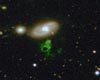 Hooghalen, Netherlands (SPX) Nov 26, 2008
New observations made by radio telescopes have finally revealed the nature of the bizarre object known as "Hanny's voorwerp" (SDSS J094103.80+344334.2). The Voorwerp was discovered by Hanny van Arkel, a Dutch school teacher and an enthusiastic volunteer of the Galaxy Zoo project. |
|
|

| The content herein, unless otherwise known to be public domain, are Copyright 1995-2007 - SpaceDaily.AFP and UPI Wire Stories are copyright Agence France-Presse and United Press International. ESA Portal Reports are copyright European Space Agency. All NASA sourced material is public domain. Additional copyrights may apply in whole or part to other bona fide parties. Advertising does not imply endorsement,agreement or approval of any opinions, statements or information provided by SpaceDaily on any Web page published or hosted by SpaceDaily. Privacy Statement |
 del.icio.us
 Digg
Digg Reddit
 YahooMyWeb
 Google
 Facebook