
 |
 |
 |
 |
 |
 |
 |
 |
 |

 |
NASA And Caltech Test Steep-Terrain Rover
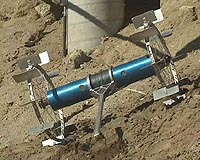
Pasadena CA (SPX) Feb 06, 2009 Engineers from NASA's Jet Propulsion Laboratory and students at the California Institute of Technology have designed and tested a versatile, low-mass robot that can rappel off cliffs, travel nimbly over steep and rocky terrain, and explore deep craters. This prototype rover, called Axel, might help future robotic spacecraft better explore and investigate foreign worlds such as Mars. On Earth, Axel might assist in search-and-rescue operations. "Axel extends our ability to explore terrains that we haven't been able to explore in the past, such as deep craters with vertically-sloped promontories," said Axel's principal investigator, Issa A.D. Nesnas, of JPL's robotics and mobility section. "Also, because Axel is relatively low-mass, a mission may carry a number of Axel rovers. That would give us the opportunity to be more aggressive with the terrain we would explore, while keeping the overall risk manageable." The simple and elegant design of Axel, which can operate both upside down and right side up, uses only three motors: one to control each of its two wheels and a third to control a lever. The lever contains a scoop to gather lunar or planetary material for scientists to study, and it also adjusts the robot's two stereo cameras, which can tilt 360 degrees. Axel's cylindrical body has computing and wireless communications capabilities and an inertial sensor to operate autonomously. It also sports a tether that Axel can unreel to descend from a larger lander, rover or anchor point. The rover can use different wheel types, from large foldable wheels to inflatable ones, which help the rover tolerate a hard landing and handle rocky terrain. Nesnas co-leads the project with Joel Burdick, a mechanical and bioengineering professor at Caltech, who supervises a handful of Caltech graduate and undergraduate students working on the rover system. Last fall, the JPL-Caltech team demonstrated Axel at the annual Smithsonian Folklife Festival in Washington, which showcased NASA for the agency's 50th anniversary. "Collaboration with Caltech has been key to the success of this project," Nesnas said. "The students contributed significantly to the design of the tethered Axel. Their creative work enabled us to analyze, design and build new wheels, sampling tools and software. The students also played a key role in field-testing this robot. Without them, we would not have been able to accomplish such goals, given our limited resources." JPL began developing Axel in 1999, in partnership with Purdue University, West Lafayette, Ind., and Arkansas Tech University, Russellville, Ark. The Axel project was funded through NASA's Exploration System Mission Directorate. Caltech manages JPL for NASA. Share This Article With Planet Earth
Related Links Axel test-run at the JPL Mars yardAxel All about the robots on Earth and beyond!
 NASA And Caltech Test Steep-Terrain Rover
 Pasadena CA (SPX) Feb 05, 2009
Engineers from NASA's Jet Propulsion Laboratory and students at the California Institute of Technology have designed and tested a versatile, low-mass robot that can rappel off cliffs, travel nimbly over steep and rocky terrain, and explore deep craters. |
|
|

| The content herein, unless otherwise known to be public domain, are Copyright 1995-2007 - SpaceDaily.AFP and UPI Wire Stories are copyright Agence France-Presse and United Press International. ESA Portal Reports are copyright European Space Agency. All NASA sourced material is public domain. Additional copyrights may apply in whole or part to other bona fide parties. Advertising does not imply endorsement,agreement or approval of any opinions, statements or information provided by SpaceDaily on any Web page published or hosted by SpaceDaily. Privacy Statement |
 del.icio.us
 Digg
Digg Reddit
 YahooMyWeb
 Google
 Facebook