
 |
 |
 |
 |
 |
 |
 |
 |
 |

 |
NASA Balloon Mission Tunes In To A Cosmic Radio Mystery
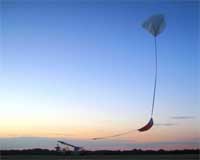
Greenbelt MD (SPX) Jan 12, 2009 Listening to the early universe just got harder. A team led by Alan Kogut of NASA's Goddard Space Flight Center in Greenbelt, Md., has announced the discovery of cosmic radio noise that booms six times louder than expected. The finding comes from a balloon-borne instrument named ARCADE, which stands for the Absolute Radiometer for Cosmology, Astrophysics, and Diffuse Emission. In July 2006, the instrument launched from NASA's Columbia Scientific Balloon Facility in Palestine, Texas, and flew to an altitude of 120,000 feet, where the atmosphere thins into the vacuum of space. ARCADE's mission was to search the sky for heat from the first generation of stars. Instead, it found a cosmic puzzle. "The universe really threw us a curve," Kogut says. "Instead of the faint signal we hoped to find, here was this booming noise six times louder than anyone had predicted." Detailed analysis ruled out an origin from primordial stars or from known radio sources, including gas in the outermost halo of our own galaxy. The source of this cosmic radio background remains a mystery. Many objects in the universe emit radio waves. In 1931, American physicist Karl Jansky first detected radio static from our own Milky Way galaxy. Similar emission from other galaxies creates a background hiss of radio noise. The problem, notes team member Dale Fixsen of the University of Maryland at College Park, is that there don't appear to be enough radio galaxies to account for the signal ARCADE detected. "You'd have to pack them into the universe like sardines," he says. "There wouldn't be any space left between one galaxy and the next." The sought-for signal from the earliest stars remains hidden behind the newly detected cosmic radio background. This noise complicates efforts to detect the very first stars, which are thought to have formed about 13 billion years ago - not long, in cosmic terms, after the Big Bang. Nevertheless, this cosmic static may provide important clues to the development of galaxies when the universe was less than half its present age. Unlocking its origins should provide new insight into the development of radio sources in the early universe. "This is what makes science so exciting," says Michael Seiffert, a team member at NASA's Jet Propulsion Laboratory in Pasadena, Calif. "You start out on a path to measure something - in this case, the heat from the very first stars - but run into something else entirely, something unexplained." Seiffert and Kogut announced the findings today at the 213th meeting of the American Astronomical Society in Long Beach, Calif. Four papers describing ARCADE's results have been submitted to The Astrophysical Journal. ARCADE is the first instrument to measure the radio sky with enough precision to detect this mysterious signal. To enhance the sensitivity of ARCADE's radio receivers, they were immersed in more than 500 gallons of ultra-cold liquid helium. The instrument's operating temperature was just 2.7 degrees above absolute zero. This is the same temperature as the cosmic microwave background (CMB) radiation, the remnant heat of the Big Bang that was itself discovered as cosmic radio noise in 1965. "If ARCADE is the same temperature as the microwave background, then the instrument's heat cannot contaminate the cosmic signal," Kogut explains. The NASA-funded project includes scientists and engineers from NASA's Goddard Space Flight Center in Greenbelt, Md.; the Jet Propulsion Laboratory in Pasadena, Calif.; the University of California at Santa Barbara; the University of Maryland; and Brazil's National Institute for Space Research. More than a dozen high school and undergraduate students participated in the payload's development. The balloon flight was conducted under the auspices of the Balloon Program Office at Wallops Flight Facility by the staff of the Columbia Scientific Balloon Facility. Share This Article With Planet Earth
Related Links Goddard's Arcade Balloon Web site NASA's scientific balloon program Aerospace News at SpaceMart.com
 Researchers Scientists Perform High Altitude Experiments
 Brookings, SD (SPX) Oct 01, 2008
South Dakota State University science climbed to new heights Sept. 18 when an unmanned, high-altitude balloon carried SDSU science experiments to an altitude of more than 76,000 feet. |
|
|

| The content herein, unless otherwise known to be public domain, are Copyright 1995-2007 - SpaceDaily.AFP and UPI Wire Stories are copyright Agence France-Presse and United Press International. ESA Portal Reports are copyright European Space Agency. All NASA sourced material is public domain. Additional copyrights may apply in whole or part to other bona fide parties. Advertising does not imply endorsement,agreement or approval of any opinions, statements or information provided by SpaceDaily on any Web page published or hosted by SpaceDaily. Privacy Statement |
 del.icio.us
 Digg
Digg Reddit
 YahooMyWeb
 Google
 Facebook