
 |
 |
 |
 |
 |
 |
 |
 |
 |

 |
NASA's Kepler Spacecraft Ready To Ship To Florida
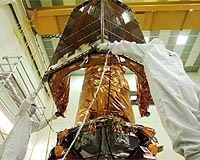
Pasadena CA (SPX) Dec 19, 2008 Engineers are getting ready to pack NASA's Kepler spacecraft into a container and ship it off to its launch site at Cape Canaveral Air Force Station, Fla. The mission, scheduled to launch on March 5, will seek to answer an age-old question - are there other Earths in space? "Kepler is ready to begin its journey to its launch site, and ultimately to space, where it will answer a question that has been pondered by humankind at least as long ago as the ancient Greeks," said James Fanson, the project manager for the mission at NASA's Jet Propulsion Laboratory, Pasadena, Calif. Kepler will monitor more than 100,000 stars for signatures of planets of various sizes and orbital distances. It has the ability to locate rocky planets like Earth, including those that lie in a star's "habitable zone," a region where liquid water, and perhaps life, could exist. If these Earth-size worlds do exist around stars like our sun, Kepler is expected to be the first to find them, and the first to measure their frequency. "Kepler's mission is to determine whether Earth-size planets in the habitable zone of other stars are frequent or rare; whether life in our Milky Way galaxy is likely to be frequent or rare," said William Borucki, the Kepler science principal investigator at NASA's Ames Research Center in Moffett Field, Calif. Kepler is currently at Ball Aerospace and Technology Corp. in Boulder, Colo. It passed all its environmental tests ensuring that it is prepared for the harsh trip to space. It also passed what's called the "pre-ship review," meaning that it is ready to be shipped via convoy to Florida in early January. Its first stop will be Astrotech in Titusville, Fla., where the spacecraft will be processed before being carried to its launch pad at Cape Canaveral. Kepler will launch atop a Delta II rocket. "An outstanding team of engineers overcame some difficult hurdles to achieve this considerable milestone," said Ball Aerospace Program Manager John Troeltzsch. "The culmination of this effort will put a spectacular mission in orbit designed to increase our understanding of the cosmos." Kepler is a NASA Discovery mission. In addition to being the home organization of the science principal investigator, NASA Ames Research Center is responsible for the ground system development, mission operations and science data analysis. Kepler mission development is managed by JPL. Ball Aerospace and Technologies Corp. is responsible for developing the Kepler flight system and supporting mission operations. Share This Article With Planet Earth
Related Links Kepler NASA's planet-finding program Lands Beyond Beyond - extra solar planets - news and science Life Beyond Earth
 Planets Form In The Eye Of A Storm
 Moffett Field CA (SPX) Dec 18, 2008
New research suggests that turbulence plays a critical role in creating ripe conditions for the birth of planets. The study, to be published in the Astrophysical Journal, challenges the prevailing theory of planet formation. Understanding how planets form is essential in determining the potential for habitable worlds beyond our solar system. |
|
|

| The content herein, unless otherwise known to be public domain, are Copyright 1995-2007 - SpaceDaily.AFP and UPI Wire Stories are copyright Agence France-Presse and United Press International. ESA Portal Reports are copyright European Space Agency. All NASA sourced material is public domain. Additional copyrights may apply in whole or part to other bona fide parties. Advertising does not imply endorsement,agreement or approval of any opinions, statements or information provided by SpaceDaily on any Web page published or hosted by SpaceDaily. Privacy Statement |
 del.icio.us
 Digg
Digg Reddit
 YahooMyWeb
 Google
 Facebook