
 |
 |
 |
 |
 |
 |
 |
 |
 |

 |
NASA Plans Test Of Electronic Nose On ISS
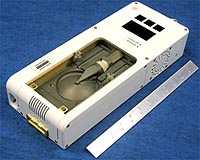
Pasadena CA (SPX) Nov 20, 2008 NASA astronauts on Space Shuttle Endeavour's STS-126 mission will install an instrument on the International Space Station that can "smell" dangerous chemicals in the air. Designed to help protect crew members' health and safety, the experimental "ENose" will monitor the space station's environment for chemicals such as ammonia, mercury, methanol and formaldehyde. The Enose fills the long-standing gap between onboard alarms and complex analytical instruments. Air-quality problems have occurred on the International Space Station, space shuttle and Russian Space Station Mir. In most cases, the chemicals were identified only after the crew had been exposed to them, if at all. The Enose, which will run continuously and autonomously, is the first instrument on station that will detect and quantify chemical leaks or spills as they happen. "The Enose is a 'first-responder' that will alert crew members of possible contaminants in the air and also analyze and quantify targeted changes in cabin environment," said Margaret A. Ryan, the principal investigator of the Enose project at NASA's Jet Propulsion Laboratory, or JPL, in Pasadena, Calif. JPL built and manages the device. Station crew members will unpack the Enose on Dec. 9 to begin the instrument's six-month demonstration in the crew cabin. If the experiment is successful, the Enose might be used in future space missions as part of an automated system to monitor and control astronauts' in-space environments. "This Enose is a very capable instrument that will increase crew awareness of the state of their air quality," said Carl Walz, an International Space Station astronaut and Director for NASA's Advanced Capabilities Division, which funds the Enose. "Having experienced an air-quality event during my Expedition 4 mission on the space station, I wish I had the information that this Enose will provide future crews. This technology demonstration will provide important information for environmental control and life-support system designers for the future lunar outpost." Specifically, the shoebox-sized Enose contains an array of 32 sensors that can identify and quantify several organic and inorganic chemical species, including organic solvents and marker chemicals that signal the start of electrical fires. The Enose sensors are polymer films that change their electrical conductivity in response to different chemicals. The pattern of the sensor array's response depends on the particular chemical types present in the air. The instrument can analyze volatile aerosols and vapors, help monitor the cleanup of chemical spills or leaks, and enable more intensive chemical analysis by collecting raw data and streaming it to a computer at JPL's Enose laboratory. The instrument has a wide range of chemical sensitivity, from fractional parts per million to 10,000 parts per million. For all of its capabilities, the Enose weighs less than nine pounds and requires only 20 watts of power. The Enose is now in its third generation. The first Enose was tested during a six-day demonstration on the STS-95 shuttle mission in 1998. That prototype could detect 10 compounds but could not analyze data immediately. The second-generation Enose could detect, identify and quantify 21 chemical species. It was extensively ground-tested. The third-generation Enose includes data-analysis software to identify and quantify the release of chemicals within 40 minutes of detection. While it will look for 10 chemical species in this six-month experiment, the new Enose can be trained to detect many others. Share This Article With Planet Earth
Related Links ENose and the Advanced Environmental Monitoring and Control Project International Space Station Station at NASA Station and More at Roscosmos S.P. Korolev RSC Energia Watch NASA TV via Space.TV Space Station News at Space-Travel.Com
 Endeavour astronaut loses tools in space
 Washington (AFP) Nov 18, 2008
An astronaut from the space shuttle Endeavour let slip her tool bag during a spacewalk Tuesday and watched helplessly as it floated off into the void of space, NASA said. |
|
|

| The content herein, unless otherwise known to be public domain, are Copyright 1995-2007 - SpaceDaily.AFP and UPI Wire Stories are copyright Agence France-Presse and United Press International. ESA Portal Reports are copyright European Space Agency. All NASA sourced material is public domain. Additional copyrights may apply in whole or part to other bona fide parties. Advertising does not imply endorsement,agreement or approval of any opinions, statements or information provided by SpaceDaily on any Web page published or hosted by SpaceDaily. Privacy Statement |
 del.icio.us
 Digg
Digg Reddit
 YahooMyWeb
 Google
 Facebook