
 |
 |
 |
 |
 |
 |
 |
 |
 |

 |

Huntsville AL (SPX) Jul 01, 2010 Spacecraft attempting to land on an unfamiliar surface need to perform a maneuver called "deep throttling" - a step that allows the vehicle to precisely throttle down to perform a smooth, controlled landing. NASA, in partnership with Pratt and Whitney Rocketdyne (PWR) headquartered in Canoga Park, Calif., has demonstrated this type of engine control capability to help design a more reliable and robust descent engine that could be used to land space exploration vehicles on the moon, an asteroid or another planet. The Common Extensible Cryogenic Engine, also known as CECE, recently completed the fourth and final series of hot-fire tests on a 15,000-pound thrust class cryogenic technology demonstrator rocket engine, increasing the throttling capability by 35 percent over previous tests. This test series demonstrated this engine could go from a thrust range of 104 percent power down to 5.9 percent. This equates to an unprecedented 17.6:1 deep-throttling capability, which means this cryogenic engine can throttle up and back down quickly. Another key objective of this test series and a successful first for this type rocket engine was to test a closed loop control system using a fuel mixture ratio component that controls the amount of liquid oxygen and liquid hydrogen entering the combustion chamber. This system also monitors the combustion chamber pressure feedback during throttling. Precise control of propellant and thrust will reduce the amount of fuel needed to land future space vehicles, reducing launch cost and weight, opening more payload capability. Landing a space vehicle on an unknown location, can be a little like driving at night where unforeseen challenges present themselves and drivers have to be able to react quickly and accurately to avoid a collision. The same is true for a spacecraft when they come upon a rock or boulder before landing. The spacecraft has to be able to throttle up quickly and accurately to avoid damaging the craft. The CECE team has worked to increase the engine's ability to throttle quickly and precisely to decrease the risks associated with landing humans and expensive space hardware. "An outstanding team of NASA and Pratt and Whitney Rocketdyne engineers worked diligently to get us to this milestone," said Tony Kim, Deep Throttling Engine Technology Development manager at NASA's Marshall Space Flight Center in Huntsville, Ala. "I couldn't be more pleased with the test results we achieved. Our collaborative teaming environment allowed our members to stretch the boundaries of engine operations." NASA will benefit from the advancements made to this technology, and I'm confident that the cosmos will be opened and available to humanity, in no small part, because of these achievements," said Frank Peri, director of the Exploration Technology Development Program at NASA's Langley Research Center, in Hampton, Va. The total test time for the technology demonstration 1.7 test series was 2,403 seconds, which, when combined with the previous three test series, brings the program's total engine test time to 7,436 seconds, or 124 minutes, providing a large amount of test data to quantify CECE performance and capability. All of the tests were conducted at a NASA owned; Pratt and Whitney Rocketdyne's operated facility in West Palm Beach, Fla. The CECE is based on the existing Pratt and Whitney Rocketdyne RL10 upper stage rocket engine. The previous RL10 track record as well as the recent technology demonstrations provides confidence and buys down risk for a possible future throttling engine development to support space exploration. The test data will allow engineers to develop simulation models to help predict engine behavior based on design parameters. The CECE collaboration includes engineers from Marshall, NASA's Glenn Research Center in Cleveland, and Pratt and Whitney Rocketdyne. NASA has invested in CECE technology since 2005 as part of the Propulsion and Cryogenics Advanced Development project at Glenn. The project is funded by the Exploration Technology Development Program in NASA's Exploration Systems Mission Directorate.
Share This Article With Planet Earth
Related Links Pratt and Whitney Rocketdyne (PWR) Rocket Science News at Space-Travel.Com

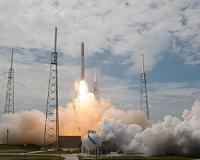 Low Density Aluminum Contributes Falcon 9 Success
Paris, France (SPX) Jun 30, 2010 Alcan Global Aerospace Transportation and Industry (Alcan Global ATI), part of Alcan Engineered Products - a business unit of Rio Tinto - congratulates SpaceX on the recent successful inaugural flight of its Falcon 9 launch vehicle from Cape Canaveral, Florida. The Falcon 9 and its Dragon spacecraft are designed to re-supply the International Space Station under contract with NASA. "Our co ... read more |
|
|
| The content herein, unless otherwise known to be public domain, are Copyright 1995-2010 - SpaceDaily. AFP and UPI Wire Stories are copyright Agence France-Presse and United Press International. ESA Portal Reports are copyright European Space Agency. All NASA sourced material is public domain. Additional copyrights may apply in whole or part to other bona fide parties. Advertising does not imply endorsement,agreement or approval of any opinions, statements or information provided by SpaceDaily on any Web page published or hosted by SpaceDaily. Privacy Statement |


 del.icio.us
 Digg
Digg Reddit
 YahooMyWeb
 Google
 Facebook


