|
 |
 |
 |
 |
 |
 |
 |
 |

 |
NASA Unveils New Antenna Network
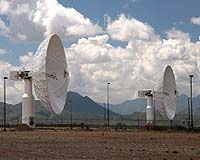
White Sands NM (SPX) Nov 09, 2007 Engineers from NASA's Goddard Space Flight Center in Greenbelt, Md., showcased the new 18-meter Ka Band Antenna Network, the first such system in agency history, during a ribbon-cutting ceremony at the White Sands Test Facility in New Mexico on November 8. "Ka band" refers to a section within the microwave portion of the electromagnetic spectrum. Much like how listeners can't pick up FM waves on AM radios and vice-versa, Ka band signals require special equipment to receive them. The three new dishes help meet the growing demand for ground stations to handle high volumes of science data generated by today's new satellites. The Ka band system allows satellites to transmit more data to the ground than ever before, in the area of 45 terabytes a month. That's about the equivalent of 1,152 fully loaded 40-gigabyte iPods! The dishes are 18.2 meters in diameter, and they need to be able to rotate quickly to acquire satellite signals. To make the dishes lighter they are largely held together with glue, rather than bolts and other fasteners. But this is no ordinary wood glue. The network makes use of a two-part epoxy developed at NASA's Jet Propulsion Laboratory in Pasadena, Calif. Tests have shown the glue and the dishes will last for decades, according to Raymond Pages, chief of Goddard's Ground System Development Office. The first missions to use the network will be the Solar Dynamics Observatory (SDO) and the Lunar Reconnaissance Orbiter (LRO). SDO will study solar variations that affect life on Earth. LRO will focus on selecting landing sites, identifying lunar resources and studying how the moon's environment will affect humans. Both probes are slated for launch in late 2008. "The design, development, and delivery of three 18-meter Ka band antenna systems in just over two years is a major accomplishment for Goddard and NASA," Pages said. "People will be munching on data [from these missions] for years to come." Once SDO and LRO conclude, the antenna network will be available for other missions. White Sands was chosen as the location for the new antennas because of the existing infrastructure available there, making it a cost-effective option. Weather was also a factor in the decision, because data must be able to reach the antennas with as little weather interference as possible for optimum quality. Datron Advanced Technologies in Simi Valley, Calif., built the antennas. Honeywell Technology Solutions Inc. in Columbia, Md., built and assembled the ground station. The Cospal Composites Srl in Ambivere, Italy, manufactured the primary reflectors. Honeywell, Datron and Goddard helped to design the antennas. Goddard manages the White Sands Complex for NASA. The total development cost of the new antenna system was $20 million. Community Email This Article Comment On This Article Related Links Space Technology News - Applications and Research
 Korean Astronaut To Ride On Soyuz April Flight With ISS Crew 17
 Moscow (RIA Novosti) Nov 07, 2007
The Russian Space Agency confirmed on Tuesday the composition of the main and back-up crews of the 17th International Space Station (ISS) expedition. The main crew, scheduled to take off on April 8, 2008 on board the Soyuz TMA-12 craft, will comprise Russian cosmonauts Commander Sergei Volkov and Flight Engineer Oleg Kononenko, and the first South Korean astronaut, Ko San. |
|
|
| The content herein, unless otherwise known to be public domain, are Copyright Space.TV Corporation. AFP and UPI Wire Stories are copyright Agence France-Presse and United Press International. ESA Portal Reports are copyright European Space Agency. All NASA sourced material is public domain. Additional copyrights may apply in whole or part to other bona fide parties. Advertising does not imply endorsement, agreement or approval of any opinions, statements or information provided by Space.TV Corp on any Web page published or hosted by Space.TV Corp. Privacy Statement |