
 |
 |
 |
 |
 |
 |
 |
 |
 |

 |
Shuttle To Launch Sunday Evening At 7:43pm
Cape Canaveral (AFP) March 15, 2009 The shuttle Discovery was set to blast off Sunday, on a mission to outfit the International Space Station with a final pair of solar wings ahead of the arrival in a few weeks of an expanded space crew. In one of the last major construction tasks of the more than decade-long effort to construct the station, the seven-member crew was to deliver and install the fourth and final pair of solar wings on the orbiting ISS. Discovery liftoff is set for 7:43 pm (2343 GMT) from the Kennedy Space Center in Florida, and meteorologists said weather conditions also were favorable for the launch. The seven astronauts are already on board the space craft in preparation for liftoff. NASA said the shuttle crew were "checking their communications gear this evening as the countdown to launch proceeds on schedule." The mission has been shortened by one day after a hydrogen leak last week led to a scrub of an earlier launch date. But NASA officials said that the problem had been cleared up and that there has been no recurrence of the glitch. "Launch controllers found no signs of a leak," the US space agency said. The leak was discovered last Wednesday, when the external tank was 98 percent full of liquid hydrogen prompting it to be emptied for the checks. The Discovery mission aims to install the solar truss, last major segment to be attached to the International Space Station, which once completed will become fully operational and capable of housing six astronauts, NASA said. The mission also will allow space officials to make a swap of personnel, exchanging Japanese astronaut Koichi Wakata for US astronaut Sandra Magnus, who will be returning to Earth after four months in space. Wakata, of the Japan Aerospace Exploration Agency, is to become the first Japanese crew member on the station. The first elements of the space station were launched in November 1998. Installing the solar panels on the 100-billion-dollar station was to take a two-astronaut team four space walks of more than six hours each to complete, according to NASA's original plans. The pairs of solar panels, containing 32,800 solar cells, are each 35 meters (115 feet) long. The final array, once in place, should boost available energy to the ISS to 120 kilowatts from the current 90. The extra power will help run the expanded array of scientific experiments to be conducted in the ISS, which saw the addition over the past year of NASA workspace and a pair of international laboratories -- Europe's Columbus and Japan's Kibo. Last week's scrubbed launch has forced space officials to shorten what had been planned as a 14-day mission to 13 days, and forced NASA to scrap one of its four planned spacewalks. Officials said the scheduling adjustments should not affect the mission to deliver and install a fourth pair of solar panels to the ISS. The main purpose of the space station is to provide a zero-gravity environment for scientific experiments. However, at present, there is insufficient staff to simultaneously conduct research and maintain the space station. With additional power provided by the soon to be installed solar panels, astronauts are expected to finish preparing the space station for full operation, to about 100 kilowatts, equivalent to that used in 40 to 50 houses. The panels will supply power for onboard laboratories and for the station's crew, which will double from three to six in May.
Details about the shuttle Discovery and its crew The shuttle was to lift off from the Kennedy Space Center in Florida carrying a crew of six American and one Japanese astronaut. Below are details about the spacecraft and its crew members. - The shuttle: Discovery is one of three NASA orbiters. The fleet also includes Atlantis and Endeavour. - Launch: Sunday at 19:43 pm local time (2343 GMT) from the Kennedy Space Center's launch complex 39-A near Cape Canaveral, Florida. - Planned duration of the mission: 13 days -- one day fewer than originally planned following the launch's delay from March 11 to March 15. - Landing: March 28 at 13:42 pm (1742 GMT) at the Kennedy Space Center, but if weather conditions are unfavorable, at Edwards Air Force Base in California's Mojave Desert. A third possible landing site is the White Sands Missile Range in New Mexico. - Initial orbit: 140 miles (225.31 kilometers) above the Earth. - Docking with ISS: 225 miles (362.1 kilometers) above the Earth. - Mission: Delivery and installation of the fourth and final set of solar arrays to the ISS to complete its electricity-generating solar panels to support the station's expanded crew, set to grow from three to six in May. - Discovery will also provide replacement parts for a system that purifies urine and other wastewater for drinking and other purposes. - Spacewalks: Three spacewalks, each lasting 6.5 hours. They are set to take place on the fifth, seventh and ninth day of the mission. - Shuttle weight before launch, including external reservoir and two solid fuel rocket boosters: 2,050 tonnes. - Orbiter and load weight at launch: 120.8 tonnes. - Orbiter weight at landing: 91.2 tonnes. - The seven crew members are: Commander Lee Archambault, 48; Pilot Tony Antonelli, 41; sission specialists Joseph Acaba, 41; Steve Swanson, 48; Richard Arnold, 45; John Phillips, 57; and Japanese astronaut Koichi Wakata, 45. - Lee Archambault, a US Air Force colonel and test pilot, has Bachelor's and Masters degrees in aeronautical/astronautical engineering. He has accumulated over 4250 flight hours in more than 30 different aircraft. After joining the US space agency in 1998, he was the pilot on STS-117 mission in June 2007, and has logged a total of 14 days in space. Archambault is married and has three children. - Tony Antonelli, an aeronautics and astronautics engineer, holds a Master's degree from the Massachusetts Institute of Technology (MIT). The US Navy commander and aviator has logged over 3,200 hours in 41 different aircraft. He joined NASA in 2000 and will make his first space flight on Discovery. He is married with two children. - Joseph Acaba, a US Marine Corps reservist and former math and science teacher, joined NASA in 2004 and completed his astronaut candidate training in 2006. STS-119 will be his first space mission. Acaba is single. - Steve Swanson, a former software engineer, has a doctorate degree from Texas A & M university and joined NASA in 1987 as a systems engineer before starting training as a mission specialist in 1998. He flew on STS-117 Atlantis in June 2007 and has completed two spacewalks that lasted over 13 hours total. - Richard Arnold, a former middle school and high school science teacher, has taught in American schools abroad. Selected as a mission specialist by NASA in 2004, he completed astronaut training in 2006 and will make his first trip to space aboard Discovery. Arnold is married with two daughters. - John Phillips is a retired US Navy captain, who has logged over 4,400 flight hours as a naval aviator. Phillips also has a geophysics and space physics doctorate degree from the University of California, Los Angeles (UCLA). After joining NASA in 1996, he flew aboard the space shuttle Endeavour in April and May 2001 for 12 days and spent six months at the ISS. Phillips has logged over 179 days in space, including a space walk that lasted nearly five hours. He is married with two children. - Koichi Wakata, an astronaut with the Japan Aerospace Exploration Agency (JAXA), has a doctorate in aerospace engineering with Kyushu University. After working as a structural engineer with Japan Airlines, he was selected as an astronaut candidate by the National Space Development Agency of Japan (NASDA) in June 1992, logging over 2,100 hours as a multi-engine and instrument rated pilot in different aircraft. In August 1992, Wakata reported to the Johnson Space Center, where he qualified as mission specialist. On Endeavour in January 1996, he flew as the first Japanese mission specialist and conducted two spacewalks. He was the first Japanese astronaut to work on ISS assembly during STS-92 Discovery in October 2000. Wakata has accumulated over 21 days and 19 hours in space. He will remain on the ISS -- the first Japanese crew member to do so -- through May to replace Expedition 18 flight engineer Sandra Magnus. Wakata is married with one child. Share This Article With Planet Earth
Related Links Shuttle at NASA Watch NASA TV via Space.TV Space Shuttle News at Space-Travel.Com
 Shuttle Repairs Work Proceeds - Weather Forecast Is Good
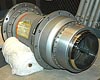 Cape Camnaveral FL (SPX) Mar 14, 2009
Repairs are under way on the Ground Umbilical Carrier Plate (GUCP) interface, where gaseous hydrogen leaked during Wednesday's launch attempt. The interface then will be retested and leak checked before Sunday's 7:43 p.m. launch attempt. |
|
|

| The content herein, unless otherwise known to be public domain, are Copyright 1995-2007 - SpaceDaily.AFP and UPI Wire Stories are copyright Agence France-Presse and United Press International. ESA Portal Reports are copyright European Space Agency. All NASA sourced material is public domain. Additional copyrights may apply in whole or part to other bona fide parties. Advertising does not imply endorsement,agreement or approval of any opinions, statements or information provided by SpaceDaily on any Web page published or hosted by SpaceDaily. Privacy Statement |
 del.icio.us
 Digg
Digg Reddit
 YahooMyWeb
 Google
 Facebook