|
 |
 |
 |
 |
 |
 |
 |

| . |  |
. |

|
|
. |

 by Staff Writers Washington DC (SPX) Jun 13, 2011
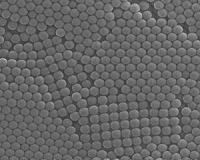
Depending on whom you ask, nanoparticles are, potentially, either one of the most promising or the most perilous creations of science. These tiny objects can deliver drugs efficiently and enhance the properties of many materials, but what if they also are hazardous to your health in some way? Now, scientists at the National Institute of Standards and Technology (NIST) have found a way to manipulate nanoparticles so that questions like this can be answered. The team has developed a method of attracting and capturing metal-based nanoparticles on a surface and releasing them at the desired moment. The method, which uses a mild electric current to influence the particles' behavior, could allow scientists to expose cell cultures to nanoparticles so that any lurking hazards they might cause to living cells can be assessed effectively. The method also has the advantage of collecting the particles in a layer only one particle thick, which allows them to be evenly dispersed into a fluid sample, thereby reducing clumping-a common problem that can mask the properties they exhibit when they encounter living tissue. According to NIST physicist Darwin Reyes, these combined advantages should make the new method especially useful in toxicology studies. "Many other methods of trapping require that you modify the surface of the nanoparticles in some way so that you can control them more easily," Reyes says. "We take nanoparticles as they are, so that you can explore what you've actually got. Using this method, you can release them into a cell culture and watch how the cells react, which can give you a better idea of how cells in the body will respond." Other means of studying nanoparticle toxicity do not enable such precise delivery of the particles to the cells. In the NIST method, the particles can be released in a controlled fashion into a fluid stream that flows over a colony of cells, mimicking the way the particles would encounter cells inside the body-allowing scientists to monitor how cells react over time, for example, or whether responses vary with changes in particle concentration. For this particular study, the team used a gold surface covered by long, positively charged molecules, which stretch up from the gold like wheat in a field. The nanoparticles, which are also made of gold, are coated with citrate molecules that have a slight negative charge, which draws them to the surface covering, an attraction that can be broken with a slight electric current. Reyes says that because the surface covering can be designed to attract different materials, a variety of nanoparticles could be captured and released with the technique. D.R. Reyes, G.I. Mijares, B. Nablo, K.A. Briggman and M. Gaitan. Trapping and release of citrate-capped gold nanoparticles. Applied Surface Science. May 27, 2011, doi:10.1016/j.apsusc.2011.04.030.
|
. |
|
| The content herein, unless otherwise known to be public domain, are Copyright 1995-2011 - Space Media Network. AFP and UPI Wire Stories are copyright Agence France-Presse and United Press International. ESA Portal Reports are copyright European Space Agency. All NASA sourced material is public domain. Additional copyrights may apply in whole or part to other bona fide parties. Advertising does not imply endorsement,agreement or approval of any opinions, statements or information provided by Space Media Network on any Web page published or hosted by Space Media Network. Privacy Statement |

 del.icio.us
 Digg
Digg Reddit
 Google