|
Nanowire battery lasts 10 times longer
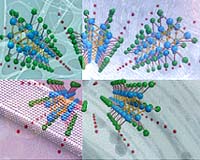
Palo Alto, Calif. (UPI) Dec 21, 2007 U.S. researchers say they've found a way to use silicon nanowires to create a new rechargeable lithium-ion battery. The device, developed at Stanford University, produces 10 times the amount of electricity of existing lithium-ion batteries. A laptop that now runs on battery for two hours could operate for 20 hours, the university said Friday in a release. Engineering professor Yi Cui said the lithium is stored in a forest of tiny silicon nanowires, each with a diameter one-thousandth the thickness of a sheet of paper. The nanowires inflate four times their normal size as they soak up lithium. The findings were published online in the journal Nature Nanotechnology. Cui said the expanded storage capacity could make Li-ion batteries attractive to electric car manufacturers. Cui suggested that they could also be used in homes or offices to store electricity generated by rooftop solar panels. Community Email This Article Comment On This Article Related Links Powering The World in the 21st Century at Energy-Daily.com
 Ener1 Chairman Predicts Lithium-ion Battery Will Be In Cars By End Of 2008
 Fort Lauderdale FL (SPX) Dec 14, 2007
Appearing Tuesday on Fox Business News, Charles Gassenheimer, chairman of Ener1 said that the company will bring its automotive Lithium-ion battery to market by the end of 2008. "Our batteries have already been tested by the United States Advanced Battery Consortium, which is General Motors, Ford and Chrysler," Mr. Gassenheimer told viewers of the Fox morning broadcast "CEO Corner." |
|
|
| The content herein, unless otherwise known to be public domain, are Copyright Space.TV Corporation. AFP and UPI Wire Stories are copyright Agence France-Presse and United Press International. ESA Portal Reports are copyright European Space Agency. All NASA sourced material is public domain. Additional copyrights may apply in whole or part to other bona fide parties. Advertising does not imply endorsement, agreement or approval of any opinions, statements or information provided by Space.TV Corp on any Web page published or hosted by Space.TV Corp. Privacy Statement |