
 |
 |
 |
 |
 |
 |
 |
 |
 |

 |

Boston MA (SPX) May 25, 2011 A local supernova factory has recently started production, according to a wealth of new data from NASA's Chandra X-ray Observatory on the Carina Nebula. This discovery may help astronomers better understand how some of the Galaxy's heaviest and youngest stars race through their lives and release newly-forged elements into their surroundings. Located in the Sagittarius-Carina arm of the Milky Way a mere 7,500 light-years from Earth, the Carina Nebula has long been a favorite target for astronomers using telescopes tuned to a wide range of wavelengths. Chandra's extraordinarily sharp X-ray vision has detected over 14,000 stars in this region, revealed a diffuse X-ray glow, and provided strong evidence that supernovas have already occurred in this massive complex of young stars. "The Carina Nebula is one of the best places we know to study how young massive stars live and die," said Leisa Townsley of Penn State University, who led the large Chandra campaign to observe Carina. "Now, we have a compelling case that a supernova show in Carina has already begun." One important piece of evidence is an observed deficit of bright X-ray sources in Trumpler 15, one of ten star clusters in the Carina complex. "This suggests that some of the massive stars in Trumpler 15 have already been destroyed in supernova explosions," said Junfeng Wang of the Harvard-Smithsonian Center for Astrophysics in Cambridge, Mass, first author of a paper on this cluster. "These stars were likely between 20 and 40 times the mass of the Sun and would have exploded in the last few million years, which is very recent in cosmic terms." The new Chandra survey also revealed the presence of six possible neutron stars, the dense cores often left behind after stars explode in supernovas, when previous observations had only detected one neutron star in Carina. Neutron stars in star-forming regions are very difficult to spot because they are characterized by low-energy X-rays, which are easily absorbed by dust and gas. Therefore, the detected neutron stars probably represent only a small fraction of the complete population, providing strong evidence that the supernova activity is ramping up. The diffuse emission observed by Chandra also supports the idea that supernovas have already erupted in Carina. Some of the diffuse X-ray emission almost certainly comes from the winds of massive stars, but some may also come from the remains of supernova explosions. Another outcome from the new Chandra survey of Carina, which represents about 300 hours of observing time spread over 9 months, is a new population of young massive stars. These stars had not been seen before because of obscuration, or because they are located outside well-studied clusters. "We may have doubled the number of known young, massive stars in Carina by looking this long with Chandra," said Matthew Povich of Penn State, first author of a paper on this new population. "Nearly all of these stars are destined to self-destruct in supernova explosions." Undoubtedly the most famous constituent of the Carina Nebula is Eta Carinae, a massive, unstable star that may be on the verge of exploding as a supernova. When it does explode, it will likely be a spectacular - yet still safe - light in the Earth's sky. These latest results suggest Eta Carinae is not alone in its volatility. "Supernovas aren't just eye-catching events, but they release newly-forged elements like carbon, oxygen and iron into their surroundings so they can join in the formation of new objects, like stars and planets," said Townsley. The Chandra survey has a large field of 1.4 square degrees, made of a mosaic of 22 individual Chandra pointings. A great deal of multi-wavelength data has been used in this campaign including infrared observations from the Spitzer Space Telescope and the Very Large Telescope (VLT). The Carina results were presented at the 218th American Astronomical Society meeting in Boston, and also appear in a special Astrophysical Journal Supplement issue of 16 papers devoted to the new Chandra observations of Carina
Share This Article With Planet Earth
Related Links Chandra Stellar Chemistry, The Universe And All Within It

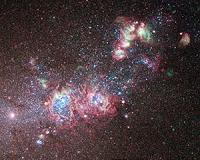 Galaxy NGC 4214 - A Star-Formation Laboratory
Baltimore MD (SPX) May 16, 2011 The dwarf galaxy NGC 4214 is ablaze with young stars and gas clouds. Located around 10 million light-years away in the constellation of Canes Venatici (The Hunting Dogs), the galaxy's close proximity, combined with the wide variety of evolutionary stages among the stars, make it an ideal laboratory to research the triggers of star formation and evolution. Intricate patterns of glowing hydr ... read more |
|
|
| The content herein, unless otherwise known to be public domain, are Copyright 1995-2010 - SpaceDaily. AFP and UPI Wire Stories are copyright Agence France-Presse and United Press International. ESA Portal Reports are copyright European Space Agency. All NASA sourced material is public domain. Additional copyrights may apply in whole or part to other bona fide parties. Advertising does not imply endorsement,agreement or approval of any opinions, statements or information provided by SpaceDaily on any Web page published or hosted by SpaceDaily. Privacy Statement |


 del.icio.us
 Digg
Digg Reddit
 YahooMyWeb
 Google
 Facebook


