
 |
 |
 |
 |
 |
 |
 |
 |
 |

 |

Manhattan KS (SPX) Mar 24, 2011 A recently patented adhesive made by Kansas State University researchers could become a staple in every astronaut's toolbox. The patent, "pH dependent adhesive peptides," was issued to the Kansas State University Research Foundation, a nonprofit corporation responsible for managing technology transfer activities of K-State. The patent covers an adhesive made from peptides - a compound containing two or more amino acids that link together - that increases in strength as moisture is removed. It was created by John Tomich, professor of biochemistry, and Xiuzhi "Susan" Sun, professor of grain science and industry. Assisting in the research was Takeo Iwamoto, an adjunct professor in biochemistry, and Xinchun Shen, a former postdoctoral researcher. "The adhesive we ended up developing was one that formed nanoscale fibrils that become entangled, sort of like Velcro. It has all these little hooks that come together," Tomich said. "It's a mechanical type of adhesion, though, not a chemical type like most commercial adhesives." Because of its unusual properties, applications will most likely be outside the commercial sector, Tomich said. For example, unlike most adhesives that become brittle as moisture levels decrease, the K-State adhesive's bond only becomes stronger. Because of this, it could be useful in low-moisture environments like outer space, where astronauts could use it to reattach tiles to a space shuttle. Conversely, its deterioration from water could also serve a purpose. "It could be used as a timing device or as a moisture detection device," Tomich said. "There could be a circuit or something that when the moisture got to a certain level, the adhesive would fail and break the circuit, sounding an alarm." The project began nearly a decade ago as Sun and a postdoctal researcher were studying the adhesive properties of soybean proteins. Needing an instrument to synthesize protein peptides, Sun contacted Tomich. Serendipitously, Tomich's lab had developed a peptide some time ago that had cement-like properties. Tomich said he knew it was unusual but had set it aside to pursue other interests. "When Dr. Sun and I resurrected this protein, we didn't use the whole thing - just a segment of it," Tomich said. "We isolated a certain segment where the cells are highly attracted to each other and form these fibrils." Since their collaboration Tomich has taken the same sequence and changed the way it was designed. The new peptide, he said, will have an eye toward gene therapy. Sun's lab is trying to optimize the sequence against adhesion, as well as study how peptide sequences influence adhesion properties and surface energy. "I continue studying protein structures and functional properties in terms of adhesion - folding, aggregation, surface energy and gelling properties - so we can rationally design and develop biobased adhesives using plant proteins," she said. The research foundation is working with the National Institute for Strategic Technology Acquisition and Commercialization to license the patent.
Share This Article With Planet Earth
Related Links Kansas State University Space Technology News - Applications and Research

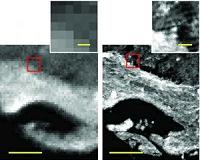 New Imaging Technique Provides Rapid, High-Definition Chemistry
Milwaukee WI (SPX) Mar 23, 2011 With intensity a million times brighter than sunlight, a new synchrotron-based imaging technique offers high-resolution pictures of the molecular composition of tissues with unprecedented speed and quality. Carol Hirschmugl, a physicist at the University of Wisconsin-Milwaukee (UWM), led a team of researchers from UWM, the University of Illinois at Urbana-Champaign and University of Illinois at ... read more |
|
|
| The content herein, unless otherwise known to be public domain, are Copyright 1995-2010 - SpaceDaily. AFP and UPI Wire Stories are copyright Agence France-Presse and United Press International. ESA Portal Reports are copyright European Space Agency. All NASA sourced material is public domain. Additional copyrights may apply in whole or part to other bona fide parties. Advertising does not imply endorsement,agreement or approval of any opinions, statements or information provided by SpaceDaily on any Web page published or hosted by SpaceDaily. Privacy Statement |


 del.icio.us
 Digg
Digg Reddit
 YahooMyWeb
 Google
 Facebook


