
 |
 |
 |
 |
 |
 |
 |
 |
 |

 |

Cleveland OH (SPX) Oct 13, 2010 Researchers at Case Western Reserve University have taken the first step to building a computer capable of operating in the heat of a jet engine or the sunny side of the planet Mercury. Te-Hao Lee, Swarup Bhunia and Mehran Mehregany, have made electromechanical switches - building blocks of circuits - that can take twice the heat that renders electronic transistors useless. Their work was published in Science last month. The engineers took their cue from English inventor Charles Babbage, who built a steam-driven machine to calculate mathematical tables in the 1830s. The group applied nanotechnology to make switches fit today's ever-smaller computing platforms. After configuring the switches into an inverter, they found the devices continue to work at more than 500 degrees Celsius - resilient enough to work inside engines of cars, jets and rockets, in deep underground drilling, even on the surface of Venus and Mercury. "They work because they're mechanical and made of silicon carbide, which is robust at high temperatures," Bhunia said. "The switches operate in high heat and radiation, at lower voltage and higher density and perform better than transistors designed to operate in high heat." While transistors have the advantage of no moving parts, they deteriorate at about 250 degree Celsius and leak electrons excited by the warmth, voiding the ability to accurately relay the current that moves data in computers. To avoid those problems Lee, a PhD student, and Bhunia and Mehregany, professors of electrical engineering and computer science, decided to build switches of heat tolerant material and in a form in which, much like a light switch, mechanical levers make contact to pass current or break contact to halt current. The group used electron beam lithography and sulfur hexafluoride gas to etch the switches, just a few hundred nanometers in size, out of silicon carbide. The result is a switch that has no discernable leakage and no loss of power in testing at 500 degrees Celsius. A pair of switches were used to make an inverter, which was able to switch on and off 500,000 times per second, performing computation each cycle. The switches, however, began to break down after 2 billion cycles and in a manner the researchers do not yet fully understand. "We made a building block," Bhunia said. "Next, we're trying to make memory. If we can combine them, we can build a computer." He and the others are confident that with improvements in production, they can build more durable switches that can cycle faster. Whether they can reach the point of competing with faster transistors for office and home and even supercomputing, remains to be seen. The researchers point out that with the ability to handle much higher heat, the need for costly and space-consuming cooling systems would be eliminated.
Share This Article With Planet Earth
Related Links Case Western Reserve University Powering The World in the 21st Century at Energy-Daily.com

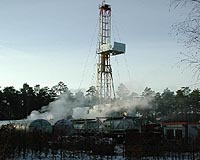 SMU Geothermal Finds Large Energy Source In Coal Country
Dallas TX (SPX) Oct 13, 2010 New research produced by Southern Methodist University's Geothermal Laboratory, funded by a grant from Google.org, suggests that the temperature of the Earth beneath the state of West Virginia is significantly higher than previously estimated and capable of supporting commercial baseload geothermal energy production. Geothermal energy is the use of the Earth's heat to produce heat and elec ... read more |
|
|
| The content herein, unless otherwise known to be public domain, are Copyright 1995-2010 - SpaceDaily. AFP and UPI Wire Stories are copyright Agence France-Presse and United Press International. ESA Portal Reports are copyright European Space Agency. All NASA sourced material is public domain. Additional copyrights may apply in whole or part to other bona fide parties. Advertising does not imply endorsement,agreement or approval of any opinions, statements or information provided by SpaceDaily on any Web page published or hosted by SpaceDaily. Privacy Statement |


 del.icio.us
 Digg
Digg Reddit
 YahooMyWeb
 Google
 Facebook


