
 |
 |
 |
 |
 |
 |
 |
 |
 |

 |
New Inspiring Planetarium Show Introduces ALMA
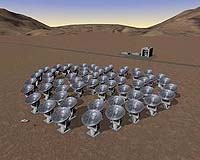
Paris, France (SPX) Mar 18, 2009 As part of a wide range of education and public outreach activities for the International Year of Astronomy 2009 (IYA2009), ESO, together with the Association of French Language Planetariums (APLF), has produced a 30-minute planetarium show, In Search of our Cosmic Origins. It is centred on the global ground-based astronomical Atacama Large Millimeter/submillimeter Array (ALMA) project and represents a unique chance for planetariums to be associated with the IYA2009. ALMA is the leading telescope for observing the cool Universe - the relic radiation of the Big Bang, and the molecular gas and dust that constitute the building blocks of stars, planetary systems, galaxies and life itself. It is currently being built in the extremely arid environment of the Chajnantor plateau, at 5000 metres altitude in the Chilean Andes, and will start scientific observations around 2011. ALMA, the largest current astronomical project, is a revolutionary telescope, comprising a state-of-the-art array of 66 giant 12-metre and 7-metre diameter antennas observing at millimetre and submillimetre wavelengths. In Search of our Cosmic Origins highlights the unprecedented window on the Universe that this facility will open for astronomers. "The show gives viewers a fascinating tour of the highest observatory on Earth, and takes them from there out into our Milky Way, and beyond," says Douglas Pierce-Price, the ALMA Public Information Officer at ESO. Edited by world fulldome experts Mirage3D, the emphasis of the new planetarium show is on the incomparable scientific adventure of the ALMA project. A young female astronomer guides the audience through a story that includes unique animations and footage, leading the viewer from the first observations by Galileo, 400 years ago, to the world of modern astronomy, moving from the visible wavelength domain to explore the millimetre-wave view of the Universe, and leaving light-polluted cities for unique settings in some of the highest and driest places on Earth. "The fascinating topic, the breathtaking ESO astronomical images, the amazing 3D computer animations, and the very clever use of the music, all make this a really inspiring show," says Agn�s Acker, President of the APLF. In search of our Cosmic Origins is available in three different formats: fulldome video, classical with video windows, and classical with slides. Fulldome video shows immerse the audience in a true 360-degree projected computer-generated virtual environment. The ALMA planetarium show is currently available in French and English. Several other language versions are in preparation: German, Italian, Spanish and Chilean Spanish, while further languages are planned: Danish, Dutch, Greek, Japanese, Portuguese and Brazilian Portuguese. The show will be available to all planetariums worldwide for a small fee, depending on the type and the size of the planetarium, to cover basic costs. Share This Article With Planet Earth
Related Links In Search of our Cosmic Origins APLF Astronomy News from Skynightly.com
 NRL Astronomers Selected For NASA's Lunar Science Institute
 Washington DC (SPX) Mar 05, 2009
NASA has selected seven academic and research teams as initial members of the agency's Lunar Science Institute (NLSI), and Naval Research Laboratory (NRL) researchers will play a substantial role on one of the teams. |
|
|

| The content herein, unless otherwise known to be public domain, are Copyright 1995-2007 - SpaceDaily.AFP and UPI Wire Stories are copyright Agence France-Presse and United Press International. ESA Portal Reports are copyright European Space Agency. All NASA sourced material is public domain. Additional copyrights may apply in whole or part to other bona fide parties. Advertising does not imply endorsement,agreement or approval of any opinions, statements or information provided by SpaceDaily on any Web page published or hosted by SpaceDaily. Privacy Statement |
 del.icio.us
 Digg
Digg Reddit
 YahooMyWeb
 Google
 Facebook