|
 |
 |
 |
 |
 |
 |
 |
 |

 |
New Japanese Humanoid Invites Grown-Ups To Play
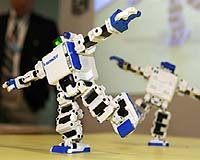
Tokyo (AFP) Jul 24, 2007 One of Japan's top toy companies said Friday it would launch small humanoids for adults to play with, hoping to tap a new market as the developed world gets older. The 16.5-centimetre (half-foot) tall robot, named i-Sobot, is able to make some 200 physical movements, including somersaults and other complex acrobatics, speaks some 180 words and responds to verbal commands. Tomy Co. Ltd. said the target audience was men in their 40s and above. "As the number of children decreases, toy makers, if they want to maintain their market, have to reach out to adults and lift the barriers between toys and high-tech products," company official Kimi Watanabe told a news conference. "There are lots of adults who dream of having a real robot but don't have the means, knowing it would cost them several hundred-thousand yen," or thousands of dollars, he said. The i-Sobot will go on sale in Japan at a cost of 30,000 yen (250 dollars) on October 25. An English-speaking version will go on sale shortly afterwards in the United States. The company chose to make the Japanese-speaking robot white and the US version black. A European launch is anticipated next year. Tomy hopes to sell 50,000 units in Japan and 300,000 worldwide. The robot will be the first product sold with Sanyo Electric Co.'s next-generation rechargeable Eneloop battery "in hope of sending an ecological message and reducing the use of disposable batteries," Watanabe said. Japan has one of the world's oldest populations as more seniors live longer and many young people decide that starting families would impose a burden on their careers or lifestyles.
Source: Agence France-Presse Community Email This Article Comment On This Article Related Links the missing link All about the robots on Earth and beyond!
 Purdue Center Uses Laser And Machining To Create Precision Parts
 West Lafayette, IN (SPX) Jul 20, 2007
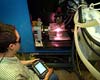
Researchers at Purdue University are perfecting a technique for manufacturing parts that have complex shapes and precision internal features by depositing layers of powdered materials, melting the powder with a laser and then immediately machining each layer. The new method can be used for creating parts made of advanced materials such as ceramics, which are difficult to manufacture and cannot be machined without first using a laser to soften the material, said Yung Shin, a professor of mechanical engineering and director of Purdue's Center for Laser-Based Manufacturing. |
|
|
| The content herein, unless otherwise known to be public domain, are Copyright Space.TV Corporation. AFP and UPI Wire Stories are copyright Agence France-Presse and United Press International. ESA Portal Reports are copyright European Space Agency. All NASA sourced material is public domain. Additional copyrights may apply in whole or part to other bona fide parties. Advertising does not imply endorsement, agreement or approval of any opinions, statements or information provided by Space.TV Corp on any Web page published or hosted by Space.TV Corp. Privacy Statement |