|
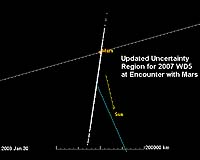
New Observations Slightly Decrease Mars Impact Probability
Pasadena CA (JPL) Jan 03, 2008 Additional position observations for asteroid 2007 WD5 taken on December 29 through January 2 have been used to improve the accuracy of the asteroid's orbit. As a result, the range of possible paths past Mars has narrowed by a factor of 3 and the most likely path has moved a little farther away from the planet, causing the Mars impact probability to decrease slightly to 3.6% (about one chance in 28). The new positional observations were made using the 2.4 meter telescope at New Mexico Tech's Magdalena Ridge Observatory and reported by astronomer Bill Ryan. It seems likely that as additional observations further shrink the uncertainty region of this asteroid, the region will no longer intersect Mars and the impact probability will quickly drop to zero. Community Email This Article Comment On This Article Related Links NASA/JPL Near-Earth Object Program Office Mars News and Information at MarsDaily.com Lunar Dreams and more
 Astronomers Monitor Asteroid To Pass Near Mars
 Pasadena CA (SPX) Dec 24, 2007
Astronomers funded by NASA are monitoring the trajectory of an asteroid estimated to be 50 meters (164 feet) wide that is expected to cross Mars' orbital path early next year. Observations provided by the astronomers and analyzed by NASA's Near-Earth Object Office at the Jet Propulsion Laboratory in Pasadena, Calif., indicate the object may pass within 30,000 miles of Mars at about 6 a.m. EST (3 a.m. PST) on Jan. 30, 2008. |
|
|
| The content herein, unless otherwise known to be public domain, are Copyright Space.TV Corporation. AFP and UPI Wire Stories are copyright Agence France-Presse and United Press International. ESA Portal Reports are copyright European Space Agency. All NASA sourced material is public domain. Additional copyrights may apply in whole or part to other bona fide parties. Advertising does not imply endorsement, agreement or approval of any opinions, statements or information provided by Space.TV Corp on any Web page published or hosted by Space.TV Corp. Privacy Statement |