
 |
 |
 |
 |
 |
 |
 |
 |
 |

 |
New Space Show Highlights IBEX's Mission Of Discovery
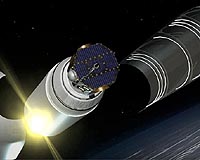
San Antonio TX (SPX) Mar 09, 2009 As part of its education and public outreach efforts, the story of NASA's Interstellar Boundary Explorer (IBEX) mission has been chronicled in a space show premiering this month at the Adler Planetarium in Chicago. The show also is being distributed free of charge and will be opening shortly in planetaria worldwide. "IBEX: Search for the Edge of the Solar System" details the IBEX spacecraft's exploration of the outer solar system using energetic neutral atom (ENA) imaging to create the first global maps of interactions between the million-mile-per-hour solar wind and the low-density material between the stars, known as the interstellar medium. Using these data, researchers will examine the structures and dynamics of the outer heliosphere and address a serious challenge facing manned exploration by studying the region that shields Earth from the majority of galactic cosmic ray radiation. The space show also spotlights a few of the countless behind-the-scene tasks involved in developing a NASA mission and the hundreds of national and international collaborators and contributors that make them happen. IBEX's unique and relatively inexpensive launch method - dropping from an aircraft and launching onboard a Pegasus rocket, before using its own solid rocket motor and hydrazine propulsion system to move into an orbit nearly out to the Moon - also is shown. "Four months since launch, and we're getting fantastic science results," says IBEX Principal Investigator Dr. David McComas, assistant vice president of the Space Science and Engineering Division at Southwest Research Institute (SwRI). "The data so far are really fascinating with clear spatial variations in both the fluxes and energies of the neutral atoms traveling in from the edge of the solar system. We'll have much to tell later this summer following the completion of the first all-sky map." A three-minute module in Adler's "TimeSpace" show preceded the new, full-length space show. "TimeSpace" aired at the planetarium from August 2005 until recently and has been seen by more than a quarter million visitors. Once the IBEX show is distributed internationally, millions will have the opportunity to see it. The launch of the IBEX space show coincides with the International Year of Astronomy, an International Astronomical Union and United Nations effort marking the 400th anniversary of the telescope and the decades of advances in astronomy and related sciences. IBEX is the latest in NASA's series of low-cost, rapidly developed Small Explorers spacecraft. The mission was developed by Southwest Research Institute with a national and international team of partners. The Goddard Space Flight Center manages the Explorers Program for NASA's Science Mission Directorate. The Adler Planetarium leads the mission's education and public outreach efforts. Share This Article With Planet Earth
Related Links Adler Planetarium IBEX mission Stellar Chemistry, The Universe And All Within It
 Mapping The Four Great Spiral Arms Of The Milky Way
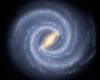 Ames IA (SPX) Jan 13, 2009
Iowa State University's Martin Pohl is part of a research team that has developed the first complete map of the Milky Way galaxy's spiral arms. |
|
|

| The content herein, unless otherwise known to be public domain, are Copyright 1995-2007 - SpaceDaily.AFP and UPI Wire Stories are copyright Agence France-Presse and United Press International. ESA Portal Reports are copyright European Space Agency. All NASA sourced material is public domain. Additional copyrights may apply in whole or part to other bona fide parties. Advertising does not imply endorsement,agreement or approval of any opinions, statements or information provided by SpaceDaily on any Web page published or hosted by SpaceDaily. Privacy Statement |
 del.icio.us
 Digg
Digg Reddit
 YahooMyWeb
 Google
 Facebook