
 |
 |
 |
 |
 |
 |
 |
 |
 |

 |

Manchester, UK (SPX) Apr 19, 2011 A team led by Professor Andre Geim, a recipient of the 2010 Nobel Prize for graphene, can now show that electric current - a flow of electrons - can magnetise graphene. The results, reported in Science, could be a potentially huge breakthrough in the field of spintronics. Spintronics is a group of emerging technologies that exploit the intrinsic spin of the electron, in addition to its fundamental electric charge that is exploited in microelectronics. Billions of spintronics devices such as sensors and memories are already being produced. Every hard disk drive has a magnetic sensor that uses a flow of spins, and magnetic random access memory (MRAM) chips are becoming increasingly popular. The findings are part of a large international effort involving research groups from the US, Russia, Japan and the Netherlands. The key feature for spintronics is to connect the electron spin to electric current as current can be manipulated by means routinely used in microelectronics. It is believed that, in future spintronics devices and transistors, coupling between the current and spin will be direct, without using magnetic materials to inject spins as it is done at the moment. So far, this route has only been demonstrated by using materials with so-called spin-orbit interaction, in which tiny magnetic fields created by nuclei affect the motion of electrons through a crystal. The effect is generally small which makes it difficult to use. The researchers found a new way to interconnect spin and charge by applying a relatively weak magnetic field to graphene and found that this causes a flow of spins in the direction perpendicular to electric current, making a graphene sheet magnetised. The effect resembles the one caused by spin-orbit interaction but is larger and can be tuned by varying the external magnetic field. The Manchester researchers also show that graphene placed on boron nitride is an ideal material for spintronics because the induced magnetism extends over macroscopic distances from the current path without decay. The team believes their discovery offers numerous opportunities for redesigning current spintronics devices and making new ones such as spin-based transistors. Professor Geim said: "The holy grail of spintronics is the conversion of electricity into magnetism or vice versa. "We offer a new mechanism, thanks to unique properties of graphene. I imagine that many venues of spintronics can benefit from this finding." Antonio Castro Neto, a physics professor from Boston who wrote a news article for the Science magazine which accompanies the research paper commented: "Graphene is opening doors for many new technologies. "Not surprisingly, the 2010 Nobel Physics prize was awarded to Andre Geim and Kostya Novoselov for their groundbreaking experiments in this material. "Apparently not satisfied with what they have accomplished so far, Geim and his collaborators have now demonstrated another completely unexpected effect that involves quantum mechanics at ambient conditions. This discovery opens a new chapter to the short but rich history of graphene".
Share This Article With Planet Earth
Related Links University of Manchester Computer Chip Architecture, Technology and Manufacture Nano Technology News From SpaceMart.com

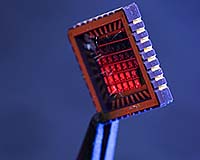 Researchers Advance Toward Hybrid Spintronic Computer Chips
Columbus OH (SPX) Apr 18, 2011 Researchers here have created the first electronic circuit to merge traditional inorganic semiconductors with organic "spintronics" - devices that utilize the spin of electrons to read, write and manipulate data. Ezekiel Johnston-Halperin, assistant professor of physics, and his team combined an inorganic semiconductor with a unique plastic material that is under development in colleague A ... read more |
|
|
| The content herein, unless otherwise known to be public domain, are Copyright 1995-2010 - SpaceDaily. AFP and UPI Wire Stories are copyright Agence France-Presse and United Press International. ESA Portal Reports are copyright European Space Agency. All NASA sourced material is public domain. Additional copyrights may apply in whole or part to other bona fide parties. Advertising does not imply endorsement,agreement or approval of any opinions, statements or information provided by SpaceDaily on any Web page published or hosted by SpaceDaily. Privacy Statement |


 del.icio.us
 Digg
Digg Reddit
 YahooMyWeb
 Google
 Facebook


