
 |
 |
 |
 |
 |
 |
 |
 |
 |

 |
New Stars From Old Gas Surprise Astronomers
Pasadena CA (SPX) Feb 20, 2009 Evidence of star birth within a cloud of primordial gas has given astronomers a glimpse of a previously unknown mode of galaxy formation. The cloud, known as the Leo Ring, appears to lack the dark matter and heavy elements normally found in galaxies today. The unexpected discovery comes thanks to instruments aboard NASA's Galaxy Evolution Explorer (GALEX) spacecraft which are sensitive to the ultraviolet radiation emitted by newly formed stars. The team, led by astronomer David Thilker of Johns Hopkins University, included Barry Madore and Mark Seibert of the Carnegie Observatories. "This demonstrates the tremendous power of observing the ultraviolet from space," said Seibert. "By discovering star formation in what is likely a new class of dwarf galaxy the Galaxy Evolution Explorer observatory is certainly living up to its name." The Leo Ring, discovered in 1983 by radio astronomers, is a cloud of hydrogen and helium gas orbiting two galaxies in the constellation Leo. The cloud is nearly invisible in optical wavelengths, and since its discovery astronomers had searched for stars within it without success. The launch of the GALEX spacecraft in 2003 with ultra-sensitive UV detectors has made it possible to explore new wavelengths and detect ultraviolet emissions from the cloud's star-forming regions, which the astronomers interpret to be small galaxies known as dwarf galaxies. Previous measurements of the masses and velocities of clumps of hydrogen within the Leo Ring suggest it lacks any significant dark matter component, an aspect that distinguishes these newly discovered sites of star formation from other known dwarf galaxies. Since in current cosmological models galaxies form in association with a massive "halo" of dark matter, this suggests that the new galaxies formed through a distinct and not yet understood process. Given the immense size of the Leo Ring it is unlikely that the gas comprising it has been cycled through or extracted from the central galaxies. It is conceivable that this gas has been untouched since the beginning of the Universe. If so, the newly formed dwarf galaxies could be almost pure hydrogen and helium and lack heavier elements ("metals" in astronomical terminology). The Leo Ring and its newly discovered ultraviolet dwarf galaxies would then provide astronomers with a nearby opportunity to see how galaxy formation probably proceeded in the very early Universe. The new type of dwarf galaxy may have been common in the early Universe, when clouds of pristine gas would have been more abundant. The discovery opens a window on the process of star formation in primordial gases not yet enriched with heavy elements. "The next phase is to follow up these objects with deep imaging and spectroscopy from the ground," said Carnegie astronomer Barry Madore, who is a co-author on the paper and a co-investigator on the GALEX mission."An observing run on Carnegie's 6.5m Baade telescope is already scheduled for this spring." Share This Article With Planet Earth
Related Links Carnegie Institution Stellar Chemistry, The Universe And All Within It
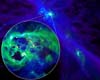
 New Recipe For Dwarf Galaxies: Start With Leftover Gas
 Pasadena CA (SPX) Feb 19, 2009
There is more than one way to make a dwarf galaxy, and NASA's Galaxy Evolution Explorer has found a new recipe. The spacecraft has, for the first time, identified dwarf galaxies forming out of nothing more than pristine gas likely leftover from the early universe. |
|
|

| The content herein, unless otherwise known to be public domain, are Copyright 1995-2007 - SpaceDaily.AFP and UPI Wire Stories are copyright Agence France-Presse and United Press International. ESA Portal Reports are copyright European Space Agency. All NASA sourced material is public domain. Additional copyrights may apply in whole or part to other bona fide parties. Advertising does not imply endorsement,agreement or approval of any opinions, statements or information provided by SpaceDaily on any Web page published or hosted by SpaceDaily. Privacy Statement |
 del.icio.us
 Digg
Digg Reddit
 YahooMyWeb
 Google
 Facebook