
 |
 |
 |
 |
 |
 |
 |
 |
 |

 |
New Storage System Design Brings Hydrogen Cars Closer To Reality
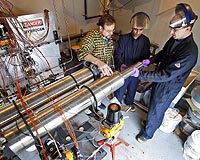
West Lafayette IN (SPX) Apr 03, 2009 Researchers have developed a critical part of a hydrogen storage system for cars that makes it possible to fill up a vehicle's fuel tank within five minutes with enough hydrogen to drive 300 miles. The system uses a fine powder called metal hydride to absorb hydrogen gas. The researchers have created the system's heat exchanger, which circulates coolant through tubes and uses fins to remove heat generated as the hydrogen is absorbed by the powder. The heat exchanger is critical because the system stops absorbing hydrogen effectively if it overheats, said Issam Mudawar, a professor of mechanical engineering who is leading the research. "The hydride produces an enormous amount of heat," Mudawar said. "It would take a minimum of 40 minutes to fill the tank without cooling, and that would be entirely impractical." Researchers envision a system that would enable motorists to fill their car with hydrogen within a few minutes. The hydrogen would then be used to power a fuel cell to generate electricity to drive an electric motor. The research, funded by General Motors Corp. and directed by GM researchers Darsh Kumar, Michael Herrmann and Abbas Nazri, is based at the Hydrogen Systems Laboratory at Purdue's Maurice J. Zucrow Laboratories. In February, the team applied for three provisional patents related to this technology. "The idea is to have a system that fills the tank and at the same time uses accessory connectors that supply coolant to extract the heat," said Mudawar, who is working with mechanical engineering graduate student Milan Visaria and Timothee Pourpoint, a research assistant professor of aeronautics and astronautics and manager of the Hydrogen Systems Laboratory. "This presented an engineering challenge because we had to figure out how to fill the fuel vessel with hydrogen quickly while also removing the heat efficiently. The problem is, nobody had ever designed this type of heat exchanger before. It's a whole new animal that we designed from scratch." The metal hydride is contained in compartments inside the storage "pressure vessel." Hydrogen gas is pumped into the vessel at high pressure and absorbed by the powder. "This process is reversible, meaning the hydrogen gas may be released from the metal hydride by decreasing the pressure in the storage vessel," Mudawar said. "The heat exchanger is fitted inside the hydrogen storage pressure vessel. Due to space constraints, it is essential that the heat exchanger occupy the least volume to maximize room for hydrogen storage." Conventional automotive coolant flows through a U-shaped tube traversing the length of the pressure vessel and heat exchanger. The heat exchanger, which is made mostly of aluminum, contains a network of thin fins that provide an efficient cooling path between the metal hydride and the coolant. "This milestone paves the way for practical on-board hydrogen storage systems that can be charged multiple times in much the same way a gasoline tank is charged today," said Kumar, a researcher at GM's Chemical and Environmental Sciences Laboratory and the GM R and D Center in Warren, Mich. "As newer and better metal hydrides are developed by research teams worldwide, the heat exchanger design will provide a ready solution for the automobile industry." The researchers have developed the system over the past two years. Because metal hydride reacts readily with both air and moisture, the system must be assembled in an airtight chamber, Pourpoint said. Research activities at the hydrogen laboratory involve faculty members from the schools of aeronautics and astronautics, mechanical engineering, and electrical and computer engineering. Share This Article With Planet Earth
Related Links Purdue University Car Technology at SpaceMart.com
 New car hydrogen storage system created
 West Lafayette, Ind., April 2, 2009
 U.S. scientists say they've created a hydrogen storage system that allows a car's fuel tank to be filled within five minutes for a 300-mile driving range. |
|
|

| The content herein, unless otherwise known to be public domain, are Copyright 1995-2007 - SpaceDaily.AFP and UPI Wire Stories are copyright Agence France-Presse and United Press International. ESA Portal Reports are copyright European Space Agency. All NASA sourced material is public domain. Additional copyrights may apply in whole or part to other bona fide parties. Advertising does not imply endorsement,agreement or approval of any opinions, statements or information provided by SpaceDaily on any Web page published or hosted by SpaceDaily. Privacy Statement |
 del.icio.us
 Digg
Digg Reddit
 YahooMyWeb
 Google
 Facebook