
 |
 |
 |
 |
 |
 |
 |
 |
 |

 |
New Study Resolves Mystery Of How Massive Stars Form
Santa Cruz CA (SPX) Jan 19, 2009 Theorists have long wondered how massive stars--up to 120 times the mass of the Sun--can form without blowing away the clouds of gas and dust that feed their growth. But the problem turns out to be less mysterious than it once seemed. A study published this week by Science shows how the growth of a massive star can proceed despite outward-flowing radiation pressure that exceeds the gravitational force pulling material inward. The new findings also explain why massive stars tend to occur in binary or multiple star systems, said lead author Mark Krumholz, an assistant professor of astronomy and astrophysics at the University of California, Santa Cruz. The formation of companion stars emerged unexpectedly from the sophisticated computer simulations the researchers used to explore the physics of massive star formation. "We didn't set out to solve that question, so it was a nice side benefit of the study," Krumholz said. "The main finding is that radiation pressure does not limit the growth of massive stars." Radiation pressure is the force exerted by electromagnetic radiation on the surfaces it strikes. This effect is negligible for ordinary light, but it becomes significant in the interiors of stars due to the intensity of the radiation. In massive stars, radiation pressure is the dominant force counteracting gravity to prevent the further collapse of the star. "When you apply the radiation pressure from a massive star to the dusty interstellar gas around it, which is much more opaque than the star's internal gas, it should explode the gas cloud," Krumholz said. Earlier studies suggested that radiation pressure would blow away the raw materials of star formation before a star could grow much larger than about 20 times the mass of the Sun. Yet astronomers observe stars much more massive than that. Krumholz and his coauthors at UC Berkeley and Lawrence Livermore National Laboratory have spent years developing complex computer codes for simulating the processes of star formation. Combined with advances in computer technology, their latest software (called ORION) enabled them to run a detailed three-dimensional simulation of the collapse of an enormous interstellar gas cloud to form a massive star. The project required months of computing time at the San Diego Supercomputer Center. The simulation showed that as the dusty gas collapses onto the growing core of a massive star, with radiation pressure pushing outward and gravity pulling material in, instabilities develop that result in channels where radiation blows out through the cloud into interstellar space, while gas continues falling inward through other channels. "You can see fingers of gas falling in and radiation leaking out between those fingers of gas," Krumholz said. "This shows that you don't need any exotic mechanisms; massive stars can form through accretion processes just like low-mass stars." The rotation of the gas cloud as it collapses leads to the formation of a disk of material feeding onto the growing "protostar." The disk is gravitationally unstable, however, causing it to clump and form a series of small secondary stars, most of which end up colliding with the central protostar. In the simulation, one secondary star became massive enough to break away and acquire its own disk, growing into a massive companion star. A third small star formed and was ejected into a wide orbit before falling back in and merging with the primary star. When the researchers stopped the simulation, after allowing it to evolve for 57,000 years of simulated time, the two stars had masses of 41.5 and 29.2 times the mass of the Sun and were circling each other in a fairly wide orbit. "What formed in the simulation is a common configuration for massive stars," Krumholz said. "I think we can now consider the mystery of how massive stars are able to form to be solved. The age of supercomputers and the ability to simulate the process in three dimensions made the solution possible." The paper describing these results is being published by Science on the Science Express web site on January 15, 2009. In addition to Krumholz, the coauthors are Richard Klein, Christopher McKee, and Stella Offner of UC Berkeley, and Andrew Cunningham of Lawrence Livermore National Laboratory. Share This Article With Planet Earth
Related Links the missing link Lands Beyond Beyond - extra solar planets - news and science Life Beyond Earth
 Astronomers Observe Heat From Hot Jupiter
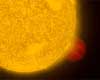 La Palma, Canary Islands (SPX) Jan 19, 2009
Two teams of astronomers have measured light emitted from extrasolar planets around sun-like stars for the first time ever using ground-based telescopes. These results were obtained simultaneously and independently by the two teams for two different planets. These landmark observations open new possibilities for studying exoplanets and their atmospheres. |
|
|

| The content herein, unless otherwise known to be public domain, are Copyright 1995-2007 - SpaceDaily.AFP and UPI Wire Stories are copyright Agence France-Presse and United Press International. ESA Portal Reports are copyright European Space Agency. All NASA sourced material is public domain. Additional copyrights may apply in whole or part to other bona fide parties. Advertising does not imply endorsement,agreement or approval of any opinions, statements or information provided by SpaceDaily on any Web page published or hosted by SpaceDaily. Privacy Statement |
 del.icio.us
 Digg
Digg Reddit
 YahooMyWeb
 Google
 Facebook