
 |
 |
 |
 |
 |
 |
 |
 |
 |

 |
New Technique Shrinks Size Of Nanotechnology Circuitry
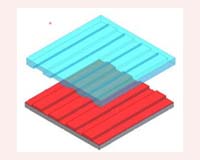
Boulder CO (SPX) Apr 20, 2009 A University of Colorado at Boulder team has developed a new method of shrinking the size of circuitry used in nanotechnology devices like computer chips and solar cells by using two separate colors of light. Like current methods in the nanoengineering field, one color of light inscribes a pattern on a substrate, said CU-Boulder Assistant Professor Robert McLeod of the electrical, computer and energy engineering department. But the new system developed by McLeod's team uses a second color to "erase" the edges of the pattern, resulting in much smaller structures. The team used tightly focused beams of blue light to record lines and dots thousands of times smaller than the width of a human hair into patterned lithography on a substrate, said McLeod. The researchers then "chopped off the edges" of the lines using a halo of ultraviolet light, trimming the width of the lines significantly. "We are essentially drawing a line with a marker on a nanotechnology scale and then erasing its edges," said McLeod. The method offers potential new approaches in the search for ways to shrink transistor circuitry, a process that drives the global electronic market that is pursuing smaller, more powerful microchips, said McLeod. A paper on the subject was published in Science Express, the online version of Science magazine. CU-Boulder co-authors included Timothy Scott and Christopher Bowman of the chemical and biological engineering department and graduate students Benjamin Kowalski and Amy Sullivan of the electrical, computer and energy engineering department. Sullivan is now a professor at Agnes Scott College in Decatur, Ga. For the project, McLeod and his team used a tabletop laser to project tightly focused beams of visible blue light onto liquid molecules known as monomers. A chemical reaction initiated a bonding of the monomers into a plastic-like polymer solid, he said. If the beam was focused in one place, it inscribed a small solid dot. If the beam was moving the focus through the material, it created a thin thread, or line. The researchers then added a second ultraviolet laser focused into a halo, or donut, which surrounded the blue light. The special monomer formulation was designed to be inhibited by the UV light, shutting down its transformation from a liquid to a solid, he said. This "halo of inhibition" prevented the edges of the spot or line from developing, resulting in a much finer final structure. The process may be another step in "Moore's Law," a trend described by Intel co-founder George Moore in 1965, which predicted that the number of transistors that can be placed on a single integrated circuit doubles about every 18 months. Since the technology industry is driven by Moore's Law, a stall in such advances would cause huge shockwaves for companies that make chips to power up devices like digital cameras, Blackberries and iPods even as they shrink them. The new technology has the potential to lead to the construction of a variety of nanotechnology devices, including "nanomotors," said McLeod. "We now have a set of new tools. We believe this is a new way to do nanotechnology." The research effort was funded by the National Science Foundation and through the University of Colorado Innovative Seed Program. A preliminary patent based on the technology has been filed by the CU-Boulder research team. Share This Article With Planet Earth
Related Links University of Colorado at Boulder Nano Technology News From SpaceMart.com Computer Chip Architecture, Technology and Manufacture
 Chemists Create Two-Armed Nanorobotic Device
 New York NY (SPX) Feb 19, 2009
Chemists at New York University and China's Nanjing University have developed a two-armed nanorobotic device that can manipulate molecules within a device built from DNA. The device is described in the latest issue of the journal Nature Nanotechnology. |
|
|

| The content herein, unless otherwise known to be public domain, are Copyright 1995-2007 - SpaceDaily.AFP and UPI Wire Stories are copyright Agence France-Presse and United Press International. ESA Portal Reports are copyright European Space Agency. All NASA sourced material is public domain. Additional copyrights may apply in whole or part to other bona fide parties. Advertising does not imply endorsement,agreement or approval of any opinions, statements or information provided by SpaceDaily on any Web page published or hosted by SpaceDaily. Privacy Statement |
 del.icio.us
 Digg
Digg Reddit
 YahooMyWeb
 Google
 Facebook