
 |
 |
 |
 |
 |
 |
 |
 |
 |

 |
New Turbines Can Cut Fuel Consumption For Business Jets
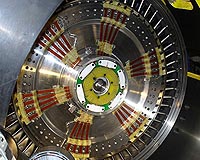
Bremen, Germany (SPX) Jan 21, 2009 Aero engines of the future should be environmentally friendly and cost-efficient. Scientists at the German Aerospace Center (Deutsches Zentrum fur Luft- und Raumfahrt; DLR) in Gottingen are currently testing an innovative single-stage supersonic high-pressure turbine on behalf of Rolls-Royce that fits that description exactly. The turbine is designed be used in business jets.
DLR test bed for high-pressure turbines unique in Germany "The only test bed in Germany suitable for this purpose is the one at DLR in Gottingen", says Dr Erik Janke, who is responsible for turbine aerodynamics at Rolls-Royce Germany. The turbine is one of the most important components of an aero engine. It transforms the energy released by fuel combustion into motion used to drive the compressor. Dr Ingo Rohle, Head of the Turbine Department (Abteilung Turbine) of the DLR Institute of Propulsion Technology (DLR-Institut fur Antriebstechnik), explains what makes the test bed in Gottingen so special: "The turbine test bed enables us to operate almost life-size high-pressure turbines using the correct Mach number and air properties. This means that we can accurately simulate the conditions that will occur when the turbine is actually used in the engine."
Engine research for environmental protection and high-tech employment in Germany The new turbine will reduce the engine's energy consumption and thus its CO2 emissions, in addition to reducing production costs. "In this way, engine research contributes in a very practical way to protecting the environment, while at the same time it helps to secure high-tech employment in Germany in general, and in the Gottingen region in particular", says Dr Rohle. The expertise gained by DLR in this field also benefits other industries, for instance in the energy sector. The first of two series of measurements for Rolls-Royce Germany was successfully completed in 2007. The results of the second series of tests, which is currently under way, will help to determine the turbine's final design. Sensors measuring pressure, temperature and other parameters determine the turbine's aerodynamic characteristics during the tests. The pressure inside the turbine, for instance, is measured using high-speed pressure transducers that collect data at a rate of 250 000 measurements per second. Over the course of the measurement campaign, this process alone generates a total data volume of 100 gigabytes that then needs to be analysed.
DLR develops a test turbine for Rolls-Royce aero engines After all, at maximum speed a rotor blade experiences a force equivalent to 37 000 times the Earth's gravitational pull. By way of comparison, an astronaut on board the Space Shuttle experiences a force of about three times the Earth's gravitational pull during takeoff. Careful assembly of the test turbine in the workshop at DLR Gottingen is also crucial to the successful completion of the measurement campaign. The project is funded through the aeronautics research programme of the German Federal Ministry of Economics and Technology (Bundesministeriums fur Wirtschaft und Technologie; BMWi). About 2.5 million euro is made available for the research conducted in Gottingen. Rolls-Royce has been a leading manufacturer of aero engines for decades. It has two sites in Germany. Thanks to the very promising results obtained so far, Rolls-Royce has already been able to successfully negotiate a contract for an engine based on this new high-pressure turbine technology. DLR is the national aerospace research centre of the Federal Republic of Germany. It employs 380 people in Gottingen, primarily in the field of aeronautics research. Share This Article With Planet Earth
Related Links German Aerospace Center Aerospace News at SpaceMart.com
 Air China expects to post 'significant loss' for 2008
 Shanghai (AFP) Jan 19, 2009
Flag carrier Air China said it expected to post a "significant loss" for last year due to shrinking passenger numbers and misjudged fuel hedging contracts. |
|
|

| The content herein, unless otherwise known to be public domain, are Copyright 1995-2007 - SpaceDaily.AFP and UPI Wire Stories are copyright Agence France-Presse and United Press International. ESA Portal Reports are copyright European Space Agency. All NASA sourced material is public domain. Additional copyrights may apply in whole or part to other bona fide parties. Advertising does not imply endorsement,agreement or approval of any opinions, statements or information provided by SpaceDaily on any Web page published or hosted by SpaceDaily. Privacy Statement |
 del.icio.us
 Digg
Digg Reddit
 YahooMyWeb
 Google
 Facebook