
 |
 |
 |
 |
 |
 |
 |
 |
 |

 |
No Small Measure: Origins Of Nanorod Diameter Discovered
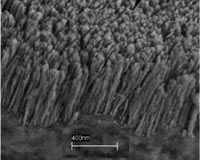
Troy NY (SPX) Mar 27, 2009 A new study answers a key question at the very heart of nanotechnology: Why are nanorods so small? Researchers at Rensselaer Polytechnic Institute have discovered the origins of nanorod diameter, demonstrating that the competition and collaboration among various mechanisms of atomic transport hold the key to nanorod size. The researchers say it is the first study to identify the fundamental reasons why nearly all nanorods have a diameter on the order of 100 nanometers. "Scientists have been fabricating nanorods for decades, but no one has ever answered the question, 'Why is that possible?'" said Hanchen Huang, professor in Rensselaer's Department of Mechanical, Aerospace, and Nuclear Engineering, who led the study. "We have used computer modeling to identify, for the first time, the fundamental reasons behind nanorod diameter. With this new understanding, we should be able to better control nanorods, and therefore design better devices." Results of the study, titled "A characteristic length scale of nanorods diameter during growth," were recently published in the journal Physical Review Letters. When fabricating nanorods, atoms are released at an oblique angle onto a surface, and the atoms accumulate and grow into nanorods about 100 nanometers in diameter. A nanometer is one billionth of a meter in length. The accumulating atoms form small layers. After being deposited onto a layer, it takes varying amounts of energy for atoms to travel or "step" downward to a lower layer, depending on the step height. In a previous study, Huang and colleagues calculated and identified these precise energy requirements. As a result, the researchers discovered the fundamental reason nanorods grow tall: as atoms are unable to step down to the next lowest layer, they begin to stack up and grow higher. It is the cooperation and competition of atoms in this process of multi-layer diffusion that accounts for the fundamental diameter of nanorods, Huang shows in the new study. The rate at which atoms are being deposited onto the surface, as well as the temperature of the surface, also factor into the equation. "Surface steps are effective in slowing down the mass transport of surface atoms, and aggregated surface steps are even more effective," Huang said. "This extra effectiveness makes the diameter of nanorods around 100 nanometers; without it the diameter would go up to 10 microns." Beyond advancing scientific theory, Huang said the discovery could have implications for developing photonic materials and fuel cell catalysts. Share This Article With Planet Earth
Related Links Rensselaer Polytechnic Institute Nano Technology News From SpaceMart.com Computer Chip Architecture, Technology and Manufacture
 Chemists Create Two-Armed Nanorobotic Device
 New York NY (SPX) Feb 19, 2009
Chemists at New York University and China's Nanjing University have developed a two-armed nanorobotic device that can manipulate molecules within a device built from DNA. The device is described in the latest issue of the journal Nature Nanotechnology. |
|
|

| The content herein, unless otherwise known to be public domain, are Copyright 1995-2007 - SpaceDaily.AFP and UPI Wire Stories are copyright Agence France-Presse and United Press International. ESA Portal Reports are copyright European Space Agency. All NASA sourced material is public domain. Additional copyrights may apply in whole or part to other bona fide parties. Advertising does not imply endorsement,agreement or approval of any opinions, statements or information provided by SpaceDaily on any Web page published or hosted by SpaceDaily. Privacy Statement |
 del.icio.us
 Digg
Digg Reddit
 YahooMyWeb
 Google
 Facebook