
 |
 |
 |
 |
 |
 |
 |
 |
 |

 |
North Korea defies pressure, launches rocket
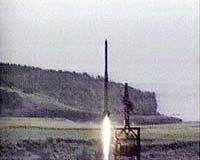
Seoul (AFP) April 5, 2009 North Korea launched a long-range rocket on Sunday, defying international pressure to hold back from what critics insisted would be an illicit missile test by the hardline communist country. Japan said it did not try to intercept the rocket, a move the North had warned would be tantamount to an act of war, but that it overflew the country and reached airspace above the Pacific Ocean. South Korea called an emergency meeting of its National Security Council, with international tensions high over the intentions of the North, which said it was peacefully testing an experimental communications satellite. "The launch took place at 11:30:15," (0230 GMT plus 15 seconds), said Kim Eun-Hye, the spokeswoman for the South Korean presidency. South Korea called the move "reckless," while the United States called it a "provocative act." The South said the rocket was carrying a satellite. The United States, Japan and South Korea see the launch as violating a UN resolution passed after the North's 2006 missile and nuclear tests. They have vowed to report Pyongyang to the UN Security Council. US, Japanese and South Korean warships with missile tracking Aegis equipment were deployed to monitor the launch, which the North insists is part of a peaceful space programme. North Korea had said the rocket's first stage would fall in the sea 75 kilometres (about 50 miles) west of Japan, and the second stage would plunge into the Pacific. The Japanese government said there were no reports of any damage or injuries in Japan from the launch, and that the rocket's boosters landed in the water as had been expected. The North had earlier announced favourable weather conditions in the morning. Analysts say North Korea wants good film footage of a launch as part of plans to maximise its propaganda value. The regime is seen as eager to give its people news of a technological triumph to bolster support at a time of lingering uncertainty over the health of leader Kim Jong-Il. There are widespread reports Kim suffered a stroke last August. While apparently largely recovered, the incident has raised questions about who would succeed the 67-year-old. North Korea is also seen as trying to strengthen its hand with Washington in future nuclear disarmament negotiations. The Taepodong-2 could reach Alaska or Hawaii at maximum range, but the North is not thought to have configured a warhead for it yet. Pyongyang has said that even a debate about its launch in the UN Security Council -- let alone any sanctions -- would cause the breakdown of long-running six-nation nuclear disarmament talks. South Korea's Unification Minister Hyun In-Taek met his deputies to check on the safety of citizens in North Korea. Seoul has advised its roughly 580 nationals in North Korea to leave the country during the launch period. US President Barack Obama has urged the regime to hold back, saying the North must learn that "it can't threaten the safety and security of other countries with impunity." But his special envoy for North Korea Stephen Bosworth has said the goal is to resume the stalled six-nation talks regardless of any launch. The North tested a Taepodong-2 for the first time in July 2006 but it failed after 40 seconds.
earlier related report Defence Minister Yasukazu Hamada apologised Saturday for the mishaps at the central and local government levels earlier that day, admitting to "a bungled transmission of information" by ministry and armed forces personnel. "This proved that Japan's crisis management is still in its infancy," charged Takehiko Yamamoto, international politics professor at Tokyo's Waseda University. "This is a bitter but important lesson for Japan." The mass-circulation Asahi Shimbun newspaper blamed "heavy pressure to disclose information swiftly" but commented that "a big quick mark now hangs over the government's crisis management." Japanese authorities had been on heightened alert since North Korea said early Saturday that preparations had been completed for a launch that, in the end, took place a day later. Tokyo, like its allies in Washington and Seoul, believes that the launch is really a test for an intercontinental ballistic missile. Japan warned that, if the rocket or its debris threatened its territory, it will use guided missile interceptors to shoot it down -- an act that Pyongyang warned it would interpret as an act of war. With tensions high, Japan's crisis management centre issued an urgent email alert around 24 hours before the actual launch, saying North Korea appeared to have fired the rocket, only to retract the message five minutes later. The defence ministry later explained that officials had misinterpreted a military radar signal picked up over the Sea of Japan (East Sea). Opposition parties also lashed out at the bungle. "It was a disastrous blunder as it raised tensions by sending the wrong information without confirmation," said Yukio Hatoyama, secretary-general of the largest opposition party, the Democratic Party of Japan. Regional officials in Japan's Akita prefecture, which lies under the rocket's expected trajectory, had earlier Saturday also mistakenly informed thousands of people that a rocket had been launched. In Akita, some 100 pupils and teachers evacuated to shelters at an elementary school, while authorities' phones ran hot with citizens' queries. Hideshi Yoshida, an official of Ogata village in Akita, said: "First of all, we need the government to send accurate information. "This is the first such experience for the government and for the prefecture, but we can learn from this lesson. Share This Article With Planet Earth
Related Links Rocket Science News at Space-Travel.Com
 Orion Launch Abort System Attitude Control Motor Thruster System Tested
 Elkton MD (SPX) Apr 03, 2009
Alliant Techsystems, NASA, and industry partners Lockheed Martin and Orbital Sciences have successfully performed a ground test firing of a sub-scale attitude control motor thruster system for the launch abort system (LAS) of NASA's Orion crew exploration vehicle (CEV). |
|
|

| The content herein, unless otherwise known to be public domain, are Copyright 1995-2007 - SpaceDaily.AFP and UPI Wire Stories are copyright Agence France-Presse and United Press International. ESA Portal Reports are copyright European Space Agency. All NASA sourced material is public domain. Additional copyrights may apply in whole or part to other bona fide parties. Advertising does not imply endorsement,agreement or approval of any opinions, statements or information provided by SpaceDaily on any Web page published or hosted by SpaceDaily. Privacy Statement |
 del.icio.us
 Digg
Digg Reddit
 YahooMyWeb
 Google
 Facebook