Energy News  
North Korean Rocket Launch Was A Successful Failure

NKorea rocket launch partial success: US expert
North Korea's rocket launch is a partial technological success on the way to building a long-range missile, even if Pyongyang failed to put a satellite in orbit, the former director of the US missile defense agency said Sunday. "It says, first of all, they had successful first staging and (were) able to control the rocket through staging," retired General Henry Obering told CNN television. "That is a significant step forward for any missile program because often times the missiles become unstable as they go through the staging events," Obering said. But the following stages failed, with part falling in the Sea of Japan and the rest in the Pacific, he told the US Cable News Network. "The fact that they did not get apparent separation of the payload from the second or third stage means that they have more work to do there in terms of being able to achieve that," he said. "The bottom line is they are continuing to advance in their ranges and I think it's why it's important that we have the ability to defend against these types of threats," Obering said. North Korea launched on Sunday a Taepodong-2 missile, which normally has three stages and an estimated range of 4,100 miles (6,700 kilometers). On July 5, 2006, North test-fired seven missiles, including a long-range Taepodong-2 which explodes after 40 seconds He said the other six launches succeeded, which amounted to a good sales pitch. Anybody who "is willing to buy the missiles they would be willing to sell to," he said "The one thing in their brochure they have not been able to demonstrate is the long-range missile," he added. North Korea has sold hundreds of ballistic missiles to Iran, Syria and Pakistan over the last decade in a bid to obtain foreign exchange, according to a study commissioned by Congress in 2007. In December 2002, 15 North Korean Scud missiles were seized from a ship headed for Yemen. A number of experts said however that North Korea does not yet have the technology needed to equip a missile with a nuclear warhead.

Russia says NKorea did not put satellite in orbit: report
A senior Russian military source on Monday confirmed US and South Korean reports that North Korea failed to place a satellite in orbit over the weekend, the Interfax news agency reported. "Our space monitoring system did not establish the placing into orbit of the North Korean satellite. According to our information, it's just not there," the source was quoted as saying. Earlier the United States and South Korea said that Sunday's launch failed to get anything into orbit.

Japan detects no NKorean satellite signals: govt
A Japanese ministry that monitors satellite radiowaves said Monday it had detected no signals from an orbiter North Korea says is transmitting its "immortal revolutionary songs" from space. The communist regime's state media said Sunday that an experimental communications satellite it had launched over Japan was transmitting songs in praise of its past and present leaders at a frequency of 470 megahertz. "So far, we have not detected any radiowaves from a North Korean satellite," said Kinya Takano, the vice minister of Japan's internal affairs ministry. North Korea on Sunday launched what was believed to be a three-stage Taepodong-2 missile, with an estimated range of 6,700 kilometers (4,100 miles). Pyongyang said it launched a satellite that was sending to Earth the "melodies of the immortal revolutionary paeans 'Song of General Kim Il-Sung' and 'Song of General Kim Jong-Il' and measured information at 470 megahertz."
by Staff Writers
Seoul (AFP) April 6, 2009
North Korea has failed in its third attempt since 1998 to build an accurate long-range missile, analysts say, undercutting its image as a defiant state able to project its power across the ocean.

The communist North claimed it had launched a satellite Sunday that was now circling the globe, transmitting data and patriotic songs praising secretive leader Kim Jong-Il.

But the United States and South Korea say the launch failed to get anything into orbit, and experts said the rocket's second and third stages apparently did not separate as planned.

"(It) was a failure," Joseph Bermudez of Jane's Information Group told AFP.

"It seems to indicate that North Korea has not been able to demonstrate a reliable system capable of being an ICBM or a space launch vehicle."

Washington, Seoul and Tokyo said the launch was a smoke-screen for testing a Taepodong-2 intercontinental ballistic missile (ICBM), which at maximum range could theoretically hit the US states of Alaska and Hawaii.

Bermudez said current information indicated the second stage did not drop, meaning the rocket was too heavy to sustain flight.

He described it as a step back from the 1998 launch of a Taepodong-1, which achieved first- and second-stage separation while the third stage failed.

The only previous test of a Taepodong-2, in 2006, lasted just 40 seconds.

Daniel Pinkston, senior analyst with the International Crisis Group (ICG) think-tank, also assessed the exercise as a failure based on reports available so far.

"There was some problem with the separation of the second and third stage," he said.

After the 2006 test North Korea tested an atomic bomb, which led the UN Security Council to pass a resolution barring the communist state from further missile-related activities.

During long-running six-nation nuclear disarmament talks, North Korea has repeatedly said it needs a deterrent against any attack by the United States, which it accuses of wanting to bring down the regime.

While the North is not believed to have configured a warhead for the Taepodong-2, a successful launch Sunday would have added to international concerns about the North's capabilities.

South Korea's National Intelligence Service described it as a successful rocket test but a failed satellite launch, according to lawmakers who attended a closed-door briefing of parliament's intelligence committee.

Chae Yeon-Seok of the Korea Aerospace Research Institute said that while the rocket apparently failed, it flew much farther than in 1998.

He called it "a big step forward in the North's rocket technology."

But the ICG's Pinkston said the stated aim of the exercise -- putting a satellite into orbit -- is technically easier than delivering a warhead, which must re-enter the atmosphere and detonate.

Nuclear expert Joseph Cirincione, president of the non-profit Ploughshares Fund, told CNN that he believed it would take years for Pyongyang to develop a serious missile threat to the United States.

"North Korea's missile and nuclear capabilities do not add up to a nuclear intercontinental ballistic missile," he wrote on the network's website.

"This third failure to create such a missile in as many attempts since 1998 likely represents the upper limits of what the country can do by stretching and adapting the Scud technology it acquired from the former Soviet Union."

Some analysts suggested the latest failure might help convince the North that its hugely expensive weapons are not buying the country security, giving Barack Obama's US administration a chance to get Pyongyang to abandon them.

"This creates an opportunity to convince them there are other ways to ensure their security," Pinkston said.

David Wright, of the Union of Concerned Scientists, told the New York Times that the incident might "open a window of opportunity" with Pyongyang -- which Pinkston said would be engaged in "soul searching" after the failure.

"But they can spin the story in all sorts of ways... they will have some footage of the rocket going up," Pinkston said.

"It's quite easy for them to depict it as a success to the vast majority of people."

Share This Article With Planet Earth
del.icio.usdel.icio.us DiggDigg RedditReddit
YahooMyWebYahooMyWeb GoogleGoogle FacebookFacebook


Related Links
Rocket Science News at Space-Travel.Com


Memory Foam Mattress Review
Newsletters :: SpaceDaily :: SpaceWar :: TerraDaily :: Energy Daily
XML Feeds :: Space News :: Earth News :: War News :: Solar Energy News


Tense minutes as NKorea rocket flew over Japan
Tokyo (AFP) April 5, 2009
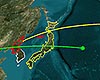
For several tense minutes North Korea's rocket sped through the skies over Japan, but the Japanese did not try to shoot it down -- a move Pyongyang had warned would amount to an act of war.


  • China's Sinopec wins oil deal from Kuwait
  • Venezuela's Chavez to visit China: govt
  • China, Ecuador move toward energy deal
  • Analysis: Russian-Turkish energy ties

  • GEH And India Nuclear Companies Sign Project Development Agreements
  • EMCOR Group Subsidiary Awarded Contracts For Bruce Nuclear Generator Station
  • Calvert Cliffs Nuclear Plant Unit 2 Returns To Full Power
  • Turbine fault closes Russian nuclear power station: report

  • Iridescent Ice Clouds From Aircraft Wings
  • Deep-Sea Rocks Point To Early Oxygen On Earth
  • Australia issues warning on Hong Kong's dirty air
  • Rendezvous With HALO

  • Indonesia should drop forest carbon credit plan: Greenpeace
  • UN climate talks: Save the forests -- but how?
  • Ecuador tops in protecting rain forest
  • Forest credits would crash carbon markets: Greenpeace

  • Climate Change Fears For Deadly Virus Outbreaks In Livestock
  • Fighting Global Warming Offers Growth And Development Opportunities
  • Fish Oils Reduce Greenhouse Gas Emissions From Flatulent Cows
  • Spreading Antibiotics In The Soil Affects Microbial Ecosystems

  • Netherlands to introduce car trade-in bonus
  • New Storage System Design Brings Hydrogen Cars Closer To Reality
  • New car hydrogen storage system created
  • Malaysia's Proton to make electric cars in Dutch tie-up

  • Airlines fear failure of global climate talks
  • State takes control of China's first private airline: report
  • Troubled private Chinese airline says president missing
  • Cathay Pacific lost 1.1 billion dollars in 2008

  • Nuclear Power In Space - Part 2
  • Nuclear Power In Space
  • Outside View: Nuclear future in space

  • The content herein, unless otherwise known to be public domain, are Copyright 1995-2007 - SpaceDaily.AFP and UPI Wire Stories are copyright Agence France-Presse and United Press International. ESA Portal Reports are copyright European Space Agency. All NASA sourced material is public domain. Additional copyrights may apply in whole or part to other bona fide parties. Advertising does not imply endorsement,agreement or approval of any opinions, statements or information provided by SpaceDaily on any Web page published or hosted by SpaceDaily. Privacy Statement