
 |
 |
 |
 |
 |
 |
 |
 |
 |

 |
Northrop Grumman Urges ABM Focus On Early Engagement And Flexibility
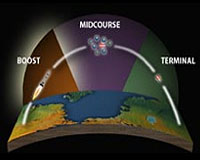
Washington DC (SPX) Apr 20, 2009 The U.S. government can get the most from valuable missile defense dollars by focusing on early intercept of hostile ballistic missiles through mobile and flexible defenses, according to Northrop Grumman. "A mobile, early intercept system stands to make the existing layer of defense much stronger while also being more affordable for taxpayers in the long run," said Larry Dodgen, who is responsible for coordinating the company's missile defense strategies as vice president of Northrop Grumman's Information Systems sector. He was commander of the U.S. Army's Space and Missile Defense Command / U.S. Army Forces Strategic Command before joining the company two years ago. His comments came during a media briefing Tuesday morning at the National Press Club in Washington, D.C. "The most value for the dollar clearly lies in shooting down ballistic missiles as early as possible after they're launched, when they are most vulnerable and before they separate into numerous, hard-to-track objects," Dodgen said. "To do that, our nation needs defenses that can deploy quickly and engage early. This will be cost-effective, because more shooters and sensors are needed to destroy a missile during its latter stages of flight." Northrop Grumman is prime contractor for two U.S. Missile Defense Agency (MDA) systems that have the strategic mobility and flexibility needed to more affordably enhance current defenses. They are: + Kinetic Energy Interceptors, a mobile, early engagement weapon system for vital regional defense on-demand to protect the homeland, allies and deployed forces overseas; and the + Space Tracking and Surveillance System, MDA's space-based sensing element, which will be the first system capable of providing worldwide coverage, tracking missiles through all phases of flight. "This is an opportune time to reassess the path forward and our overall missile defense strategy," Dodgen said. "Do we content ourselves with defenses primarily against two countries - North Korea and Iran - or do we shift to mobile capabilities that could strengthen existing defenses and at the same time prepare the country for emerging and more complex threats?" Dodgen contended that standing still in missile defense is falling behind because countries hostile to the U.S. are making rapid advances in ballistic missile and nuclear weapons technologies. "MDA has a portfolio of future programs with the capabilities needed to move forward. KEI and STSS are global for addressing shifting threats; mobile for responding from anywhere; layered for multiple shots at a target; and more affordable than maintaining fixed or ground-based missiles," he said. Share This Article With Planet Earth
Related Links KEI and STSS Learn about missile defense at SpaceWar.com Learn about nuclear weapons doctrine and defense at SpaceWar.com All about missiles at SpaceWar.com Learn about the Superpowers of the 21st Century at SpaceWar.com
 Radar offer for US missile system still on: Russia
 Baku (AFP) March 12, 2009
Russia's offer of a Soviet-era radar station in Azerbaijan as an alternative to US missile defence sites in Eastern Europe remains on the table, Russian Foreign Minister Sergei Lavrov said Thursday. |
|
|

| The content herein, unless otherwise known to be public domain, are Copyright 1995-2007 - SpaceDaily.AFP and UPI Wire Stories are copyright Agence France-Presse and United Press International. ESA Portal Reports are copyright European Space Agency. All NASA sourced material is public domain. Additional copyrights may apply in whole or part to other bona fide parties. Advertising does not imply endorsement,agreement or approval of any opinions, statements or information provided by SpaceDaily on any Web page published or hosted by SpaceDaily. Privacy Statement |
 del.icio.us
 Digg
Digg Reddit
 YahooMyWeb
 Google
 Facebook