
 |
 |
 |
 |
 |
 |
 |
 |
 |

 |
Nuts at dawn: Britain's squirrels fight for survival
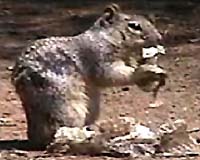
London (AFP) April 23, 2009 Deep in the heart of England's seemingly peaceful countryside, a fierce battle for survival is being waged between the domestic red squirrel, its tougher grey cousin -- and a new mutant arrival. Where there were once 3.5 million red squirrels in Britain, only about 150,000 remain. About 75 percent of these live in the wild in Scotland, while most of the rest are protected in nature reserves in northern England. A plethora of organisations comprising hundreds of members have sprung up in their support, and in recent months they have stepped up their efforts to check the cause of this slaughter -- the grey squirrel. Imported from the United States in 1876 to populate country estates, the greys were larger and had thicker fur than their English cousins and quickly began to dominate -- so much so that in 1930, it became illegal to release them into the wild. But the containment policy failed and the greys began to encroach on the reds' territory, with disastrous results. The reds were less hardy than their American cousins -- they need more space and their food takes longer to ripen -- but it was the squirrel pox virus that did the most harm. Greys are immune, but it proves fatal for reds. "It can take only one grey squirrel to introduce this virus to a local population of red squirrels, and then the virus can spread throughout the reds with devastating effect," says the group Save our Squirrels (SOS). As a result, red squirrels -- viewed in the early 20th century as a pest to be hunted down and killed -- have been a protected species since 1981. At the same time, the reputation of the greys, who now number about 2.5 million in England and Wales, gets worse and worse. -- The mutants have been dubbed 'super-squirrel' -- --------------------------------------------------- Some organisations believe in radical action. The Red Squirrel Protection Partnership (RSPP), in Northumberland in northern England, has a clear plan -- to trap and kill as many grey squirrels as possible. According to the RSPP's website, 22,287 squirrels have been killed since January 2007, as supporters act with military-style precision. Some of these end up on the butcher's block or on restaurant menus. "We only call ourselves the Red Squirrel Protection Partnership because if we called it the Grey Squirrel Annihilation League people might be a bit less sympathetic," supporter Baron Rupert Mitford told the Guardian newspaper. Public organisations have so far shied away from such a radical solution but the tactic is gaining ground. For example, the Saving Scotland's Red Squirrels project, launched in February by a coalition of Scottish groups, purports to protect the habitat of red squirrels and "control" the grey population. A few timid voices defend the greys, however, noting they face a similar fate to the red squirrels at the hand of a new arrival -- the black squirrel. These are the result of a genetic mutation of the grey squirrels and are spreading across Britain from East Anglia, where the greys were first introduced. According to a study by Alison Thomas, a geneticist at Anglia Ruskin University in Cambridge, the black squirrel made up almost half the rodent population in some areas at the beginning of 2008. "The estimate is about 25,000 (black squirrels) today, but the black mutation gene has a dominant aspect which explains their rapid increase," she told AFP. With a thicker coat and a higher level of testosterone than either the red or grey squirrels, the black mutants have been dubbed the "super-squirrel" and are proving more attractive to females -- ensuring their population flourishes. Share This Article With Planet Earth
Related Links Darwin Today At TerraDaily.com
 'G8-Plus' vow stronger commitments on protecting biodiversity
 Syracuse, Italy (AFP) April 23, 2009
The environment ministers of rich and emerging nations Thursday pledged new commitments to stopping biodiversity loss even with resources hit hard by the global financial crisis. |
|
|

| The content herein, unless otherwise known to be public domain, are Copyright 1995-2007 - SpaceDaily.AFP and UPI Wire Stories are copyright Agence France-Presse and United Press International. ESA Portal Reports are copyright European Space Agency. All NASA sourced material is public domain. Additional copyrights may apply in whole or part to other bona fide parties. Advertising does not imply endorsement,agreement or approval of any opinions, statements or information provided by SpaceDaily on any Web page published or hosted by SpaceDaily. Privacy Statement |
 del.icio.us
 Digg
Digg Reddit
 YahooMyWeb
 Google
 Facebook