
 |
 |
 |
 |
 |
 |
 |
 |
 |

 |

Laurel MD (APL) Feb 21, 2011 After more than a dozen laps through the inner solar system, NASA's Messenger spacecraft will move into orbit around Mercury on March 17, 2011. The durable spacecraft - carrying seven science instruments and fortified against the blistering environs near the Sun - will be the first to orbit the innermost planet. At 8:45 p.m. EDT, Messenger - having pointed its largest thruster very close to the direction of travel - will fire that thruster for nearly 14 minutes, with other thrusters firing for an additional minute, slowing the spacecraft by 862 meters per second (1,929 miles per hour) and consuming 31% of the propellant that the spacecraft carried at launch. Less than 9.5% of the usable propellant at the start of the mission will remain after completing the orbit insertion maneuver, but the spacecraft will still have plenty of propellant for future orbit correction maneuvers. The orbit insertion will place the spacecraft into an initial orbit about Mercury that has a 200 kilometer (124 mile) minimum altitude and a period of 12 hours. At the time of orbit insertion, Messenger will be 46.14 million kilometers (28.67 million miles) from the Sun and 155.06 million kilometers (96.35 million miles) from Earth. "The journey since launch, more than six and a half years ago, has been a long one," says Messenger Principal Investigator Sean Solomon, of the Carnegie Institution of Washington. "But we have rounded the last turn, and the finish line for the mission's cruise phase is in sight. The team is ready for orbital operations to begin." Engineers recently tested the arrayed-antenna configuration that will be used during the Mercury orbit insertion. During the maneuver, Messenger's orientation will be optimized to support the burn, not to support communications with the team on the ground. As a result, the signal home will be weaker than usual. To boost the signal, communications engineers will use four antennas at the Goldstone Deep Space Communications Complex - one 70-meter dish and three 34-meter dishes. "This arrangement is not typical for a maneuver, so we wanted to do a few dry runs before orbit insertion," says Messenger Communications Engineer Dipak Srinivasan, of the Johns Hopkins University Applied Physics Laboratory (APL) in Laurel, Md. "We are still analyzing the data, but everything went as expected." Since the last deep-space maneuver (DSM) almost a year and a half ago, the primary focus of the team has been on preparing for the orbit insertion maneuver and for orbital operations. Detailed plans have been developed and vetted through an extensive series of meetings ranging from internal peer reviews of each subsystem to formal reviews with external experts assessing overall readiness. Three of the major reviews were dedicated specifically to the activities associated with the MOI maneuver itself. In addition to taking advantage of planned DSMs to practice aspects of the orbit insertion maneuver, the team has conducted a number of flight tests to characterize key subsystem behavior and to confirm the proper operation of various spacecraft components. Three full-team rehearsals using the hardware simulator have been conducted to practice all activities to be followed during the upcoming maneuver. The first of these exercises mimicked a nominal orbit insertion, and the following two presented anomalies for the team to recognize, analyze, and address. "Although we feel that the preparations to date - and those scheduled for the next month - have been well thought-out, that the decisions made to define the specific activities were sound, and that the level of review and rehearsal has been more than adequate, we recognize the extraordinary complexity and unique nature of this endeavor," says APL's Peter Bedini, Messenger's project manager. "But at this point, four weeks out, we are well positioned for success. The spacecraft is healthy, continues to operate nominally, and is on course to be at the right place at the right time at 8:45 P.M. ET on the evening of March 17."
Share This Article With Planet Earth
Related Links Messenger at APL News Flash at Mercury Mars News and Information at MarsDaily.com Lunar Dreams and more

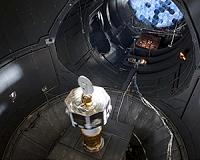 ESA's Mercury Mapper Feels The Heat
Paris, France (ESA) Jan 19, 2011 Key components of the ESA-led Mercury mapper BepiColombo have been tested in a specially upgraded European space simulator. ESA's Large Space Simulator is now the most powerful in the world and the only facility capable of reproducing Mercury's hellish environment for a full-scale spacecraft. The Mercury Magnetospheric Orbiter (MMO) has survived a simulated voyage to the innermost planet. ... read more |
|
|
| The content herein, unless otherwise known to be public domain, are Copyright 1995-2010 - SpaceDaily. AFP and UPI Wire Stories are copyright Agence France-Presse and United Press International. ESA Portal Reports are copyright European Space Agency. All NASA sourced material is public domain. Additional copyrights may apply in whole or part to other bona fide parties. Advertising does not imply endorsement,agreement or approval of any opinions, statements or information provided by SpaceDaily on any Web page published or hosted by SpaceDaily. Privacy Statement |


 del.icio.us
 Digg
Digg Reddit
 YahooMyWeb
 Google
 Facebook


