
 |
 |
 |
 |
 |
 |
 |
 |
 |

 |

London, UK (SPX) Jul 06, 2010 Once thought to be "evolutionary leftovers", new research has shown that ostriches in fact use their feathered forelimbs as sophisticated air-rudders and braking aids. According to the researchers, wing-use and hindlimb function in ostriches may help palaeontologists in their quest to reconstruct locomotor techniques in bipedal (two-legged) dinosaurs. The scientists present their research at the Society for Experimental Biology Annual Conference in Prague on Thursday 1st July 2010. Scientists have tended to disregard the use of wings in studies of ostrich locomotion, believing they were mainly for display and temperature-control purposes. New, long-term observations of hand-raised ostriches, model calculations and air-stream experiments have shown that these flightless birds can efficiently channel aerodynamic forces and consistently use their wings during rapid breaking, turning and zigzag manoeuvres. The results of this new study could mean that some of the largest and fastest-moving dinosaurs, such as the 8m long Gigantoraptor, also used feathered forelimbs for increased stability and manoeuvrability when moving at speed. Palaeontologists have previously suggested that dinosaur forelimbs were used for "catching flying insects, grabbing branches or ripping out flesh from carcasses", explained lead researcher Dr Nina Schaller, who works with the Senckenberg Research Institute in Frankfurt and the University of Antwerp. The scientists also found that a small intertarsal muscle, previously regarded as "rudimentary", actually plays a crucial role in ostrich locomotion. If a comparable mechanism existed in extinct theropod dinosaurs that shared similar running styles and habitat, the energetic cost of carrying a heavy body would have been reduced, leaving the dinosaur more fuel to run longer and faster. Dr Schaller hand-raised the ostriches for her research to ensure they could be studied in a natural, controlled environment which allowed them free space to perform without constraint. "Ostriches can be very dangerous and can react with violent (even lethal) kicks and so it was crucial that we shared a deep level of mutual trust", she explained. As well as the possible link to dinosaurs, Dr Schaller described similar wing uses in other modern flightless birds. "South American rheas execute rapid zigzagging as a means of escape and use their wings to maintain balance during these agile manoeuvres", she explained. However, other relatives such as the Australian emu and the Cassowary have very small wings which they hold very tightly to their body and are not used in locomotion. "There seems to be a very direct link between wing-size and function", she added. Future work will continue to examine ostrich wing characteristics and will hopefully establish additional links between ostrich and theropod dinosaur locomotion, say the researchers.
Share This Article With Planet Earth
Related Links Society for Experimental Biology Darwin Today At TerraDaily.com

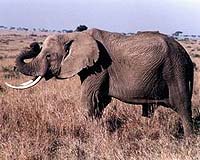 Malians mobilise to protect dwindling elephant population
Banzena, Mali (AFP) July 5, 2010 Ali Ag Rhissa, a young Touareg nomad, sits in his tent, his gun ready, on the frontline of one of Mali's battles - protecting its majestic but dwindling herds of desert elephants. Faced with the dual threat of drought and poachers, the elephant population has almost halved in recent decades. But help is at hand from local people in northern Mali, who have started to form conservation br ... read more |
|
|
| The content herein, unless otherwise known to be public domain, are Copyright 1995-2010 - SpaceDaily. AFP and UPI Wire Stories are copyright Agence France-Presse and United Press International. ESA Portal Reports are copyright European Space Agency. All NASA sourced material is public domain. Additional copyrights may apply in whole or part to other bona fide parties. Advertising does not imply endorsement,agreement or approval of any opinions, statements or information provided by SpaceDaily on any Web page published or hosted by SpaceDaily. Privacy Statement |


 del.icio.us
 Digg
Digg Reddit
 YahooMyWeb
 Google
 Facebook


