
 |
 |
 |
 |
 |
 |
 |
 |
 |

 |
Pakistan quake kills 170, leaves thousands homeless
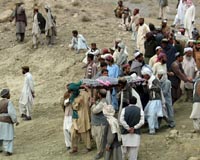
Wam, Pakistan (AFP) Oct 30, 2008 Thousands of people in mountainous southwest Pakistan on Wednesday bedded down for a freezing night in the open, after a powerful earthquake destroyed their homes and killed at least 170. The 6.4-magnitude pre-dawn quake flattened mud houses and triggered landslides in the impoverished province of Baluchistan, killing or injuring their occupants as they slept. Survivors were sent screaming into the streets in panic, eyewitnesses said. At least eight villages were badly hit by the massive tremors, local police and officials said, voicing fears that some 46,000 people living in the wider region could now be in need of shelter and other assistance. An AFP correspondent in one of the worst-affected villages, Wam, said emergency tents had not yet arrived and exhausted villagers had hunkered down in the ruined shells of their homes as temperatures plunged below zero. They spent the day in a desperate search for loved ones or burying the dead in mass graves, as aftershocks nearly as big as the initial quake pounded the landscape, sending rocks spewing from nearby peaks and sparking fresh panic. "The local graveyard has been devastated and we have no alternative. We have to bury them in mass graves," said local teacher Malik Abdul Hamid, 35. He said he had lost 15 family members. "We have so far buried 140 bodies in two mass graves. The dead were mostly women and children." Dilawar Kakar, mayor of the historic hill town of Ziarat, about 50 kilometres (30 miles) north of the provincial capital Quetta, told AFP the death toll stood at 170, while about 400 people in the area were injured. Virtually all houses were reduced to rubble either in the initial quake or by aftershocks. Schools and hospitals were also damaged, he added. Earlier Khushal Khan, spokesman for the provincial revenue minister Zamarak Khan, said local people had told him about 6,000 people have been made homeless and in one case, 29 members of the same family died. Pakistani President Asif Ali Zardari and Prime Minister Yousuf Raza Gilani both expressed their condolences to relatives of those killed and injured, the state-run Associated Press of Pakistan said. The World Health Organisation (WHO) said it would send enough medical aid and supplies for 50,000 people for three months in the wake of the disaster, while the United States offered an unspecified humanitarian relief package. "We are currently working with the Pakistani government, the UN (United Nations) and other potential donors to assess the damage," US State Department spokesman Sean McCormack told reporters. "Once we are able to make that assessment and also talk to the Pakistani government about what their needs might be, we will stand ready to provide an assistance package," McCormack said. Neighbour and rival India quickly offered any help that might be required, along with Turkey's Red Crescent. Two teams from the International Committee of the Red Cross have already arrived in the area and are assessing the situation and the needs of the survivors, the humanitarian body said from Geneva. The first official government figures from the National Disaster Management Authority (NDMA) put the death toll at 115 so far, with nearly 300 injured, its chairman, retired Lieutenant General Farooq Ahmed, told a news conference. Most of the victims were from outlying villages, but buildings collapsed in Ziarat and communications were cut while the main road to Quetta was also hit, with wide cracks and boulders blocking the way, an AFP reporter said. Soldiers, helicopters, tents, blankets, food and medical help have been sent from Quetta to Ziarat and an aerial assessment of the damage has begun, the Pakistani military said. "We have asked the government to send at least 10,000 tents as the temperature in the mountainous town is sub-zero and people need shelter during the night," said Kakar, Ziarat's mayor. There were no immediate reports of casualties or structural damage in neighbouring Afghanistan, which borders the province, police there said. Ziarat is a historic hill resort famed for its juniper forests. It receives visitors from all over Pakistan in summer who come to see the holiday home of the country's founder, Mohammed Ali Jinnah. A 7.6-magnitude earthquake in northwest Pakistan and Kashmir killed 74,000 people and displaced 3.5 million in October 2005. In 1935 a massive quake killed around 30,000 people in Quetta, which at the time was part of British-ruled India. burs/phz/dk/sst Community Email This Article Comment On This Article Share This Article With Planet Earth
Related Links Bringing Order To A World Of Disasters When the Earth Quakes A world of storm and tempest
 Catching Quakes With Laptops
 Riverside CA (SPX) Oct 29, 2008
Inside your laptop is a small accelerometer chip, there to protect the delicate moving parts of your hard disk from sudden jolts. It turns out that the same chip is a pretty good earthquake sensor, too-especially if the signals from lots of them are compared, in order to filter out more mundane sources of laptop vibrations, such as typing. |
|
|

| The content herein, unless otherwise known to be public domain, are Copyright 1995-2007 - SpaceDaily.AFP and UPI Wire Stories are copyright Agence France-Presse and United Press International. ESA Portal Reports are copyright European Space Agency. All NASA sourced material is public domain. Additional copyrights may apply in whole or part to other bona fide parties. Advertising does not imply endorsement,agreement or approval of any opinions, statements or information provided by SpaceDaily on any Web page published or hosted by SpaceDaily. Privacy Statement |
 del.icio.us
 Digg
Digg Reddit
 YahooMyWeb
 Google
 Facebook