
 |
 |
 |
 |
 |
 |
 |
 |
 |

 |
Phoenix probe mission on Mars ends: NASA
Washington (AFP) Nov 10, 2008 NASA scientists said Monday the Phoenix Mars lander has gone silent because of a lack of sunlight needed to power its batteries, after a five-month mission that produced a mother lode of scientific data from the red planet. After operating two months longer than scientists had initially planned, the probe ceased all communications with Earth starting on November 2, said Barry Goldstein, Phoenix project manager, in a telephone conference. "We are declaring an end of operations," Goldstein said at NASA's Jet Propulsion Laboratory in Pasadena, California. The US space agency would continue to listen closely in case Phoenix revives and "phones home" but scientists say such a scenario is unlikely given the deteriorating weather conditions on Mars. The Phoenix mission ended as anticipated because diminishing sunlight and a drop in temperatures meant the probe's solar arrays could no longer recharge the spacecraft's batteries. In addition to shorter days, the lander is receiving less light because of a dustier Martian sky and more clouds, as the northern Mars summer changes to autumn, scientists said. While Phoenix's work was effectively over, scientists with NASA's Mars Exploration Program told reporters they were pleased with how the lander performed and said analysis of all the rich data collected had only just begun. "Phoenix has given us some surprises, and I'm confident we will be pulling more gems from this trove of data for years to come," said Phoenix Principal Investigator Peter Smith of the University of Arizona in Tucson. The Phoenix probe had verified that frozen water existed in the Martian arctic, he said. The US orbiter Mars Odyssey was the first to detect the presence of ice on Mars' north pole in 2002. "The study of ice kept us busy for the last five months. We excavated to the ice, we know its depth, how it changes over the surface, we have seen different types of ice," Smith said. He added that "really the mission was about water and that will keep us busy for some time as we try to really understand what we've got." Phoenix advanced the scientific goal of trying to understand whether Mars once supported life, NASA officials said. "Phoenix provided an important step to spur the hope that we can show Mars was once habitable and possibly supported life," said Doug McCuistion, director of the Mars Exploration Program at NASA Headquarters in Washington. The probe also found for the first time that the planet has a moderately alkaline soil, as well as small concentrations of salts that could serve as nutrients for life and calcium carbonate -- a marker for liquid water, NASA said. Phoenix's cameras beamed back more than 25,000 images from breath-taking Martian vistas to pictures of fine particles, using the first atomic force microscope ever used outside Earth. Phoenix, which launched on August 4, 2007, touched down on Mars on May 25, 2008, further north on the Red Planet than any previous spacecraft that landed on the Martian surface. "Phoenix not only met the tremendous challenge of landing safely, it accomplished scientific investigations on 149 of its 152 Martian days as a result of dedicated work by a talented team," said Goldstein. Share This Article With Planet Earth
Related Links Mars News and Information at MarsDaily.com Lunar Dreams and more
 Mars Phoenix Lander Finishes Successful Work On Red Planet
 Los Angeles CA (SPX) Nov 11, 2008
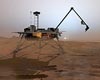
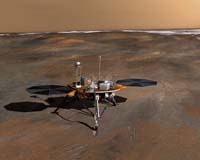
NASA's Phoenix Mars Lander has ceased communications after operating for more than five months. As anticipated, seasonal decline in sunshine at the robot's arctic landing site is not providing enough sunlight for the solar arrays to collect the power necessary to charge batteries that operate the lander's instruments. |
|
|

| The content herein, unless otherwise known to be public domain, are Copyright 1995-2007 - SpaceDaily.AFP and UPI Wire Stories are copyright Agence France-Presse and United Press International. ESA Portal Reports are copyright European Space Agency. All NASA sourced material is public domain. Additional copyrights may apply in whole or part to other bona fide parties. Advertising does not imply endorsement,agreement or approval of any opinions, statements or information provided by SpaceDaily on any Web page published or hosted by SpaceDaily. Privacy Statement |
 del.icio.us
 Digg
Digg Reddit
 YahooMyWeb
 Google
 Facebook