
 |
 |
 |
 |
 |
 |
 |
 |
 |

 |
Pizza Tossing Art Unlocks Secrets Of Tiny Motors
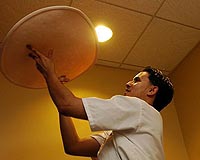
Caulfield, Australia (SPX) Apr 28, 2009 Monash University scientists have unlocked the physics of the perfect pizza toss and will use it to design the next generation of micro motors thinner that a human hair. Mr Daniel (Kuang-Chen) Liu, a PhD student supervised by Associate Professor James Friend and Senior Lecturer Leslie Yeo, videotaped a professional pizza tosser at work. The team from Monash's Micro/Nanophysics Research Laboratory, then calculated how best to describe the way the dough travels through the air - including how much the dough rotates, how quickly it spins, its stability and the energy efficiency of the toss itself. The result is a set of nonlinear differential equations that captures the art of pizza tossing. "In brief, if you toss a pizza dough one toss at a time - that is, if you toss then catch - your hands should move in a helical fashion, like they are moving along a spiral, a curved line laid along a cylinder," Associate Professor Friend said. "If you are tossing the pizza continuously, not stopping to catch it and stop every time, then your hands should move in circles." The model could help researchers to design the next generation of standing wave ultrasonic motors (SWUMs), which operate on similar principles as pizza tossing. The tiny motors have the potential to be used for minimally invasive neuro-microsurgery. In these electric motors, the fixed component, the stator, is made to vibrate ultrasonically, and this causes the moveable part, the disc-like rotor, to be "tossed" - both rotated and lifted. "The SWUM works exactly like a pizza chef tossing dough, with the hands representing the vibrating stator of the SWUM and the dough representing the rotor. The difference is only in the details: a chef tosses dough, about once a second, a few tens of centimetres into the air. A SWUM tosses the rotor a few million times a second into the air," Associate Professor Friend said. He said scientists around the world have been using trial and error to make variations of the SWUMs, and while they might have worked, there had not been a thorough understanding of the forces involved until now. "Some of the maths are a bit tricky," Dr Friend said. "The most puzzling questions with SWUMs are answered in this study. We think that further investigation of the work will prove fruitful for the understanding and design of SWUMs." The scientists are the same principals who recently developed the world's smallest useful motor, only a quarter of a millimetre wide, that could be used in the propulsion system of miniature machines to swim through the bloodstream to inaccessible places, potentially revolutionising future surgical procedures. Share This Article With Planet Earth
Related Links Monash University Nano Technology News From SpaceMart.com Computer Chip Architecture, Technology and Manufacture
 Green Nanotech Helps Consumers And Industry Save Money
 Naples FL (SPX) Apr 24, 2009
Nanotechnology has been the talk of science for creating new drug delivery systems and making electronics smaller, but a Delaware company, Industrial Nanotech, has brought nanotech down to earth and made it 'green' at the same time. |
|
|

| The content herein, unless otherwise known to be public domain, are Copyright 1995-2007 - SpaceDaily.AFP and UPI Wire Stories are copyright Agence France-Presse and United Press International. ESA Portal Reports are copyright European Space Agency. All NASA sourced material is public domain. Additional copyrights may apply in whole or part to other bona fide parties. Advertising does not imply endorsement,agreement or approval of any opinions, statements or information provided by SpaceDaily on any Web page published or hosted by SpaceDaily. Privacy Statement |
 del.icio.us
 Digg
Digg Reddit
 YahooMyWeb
 Google
 Facebook