
 |
 |
 |
 |
 |
 |
 |
 |
 |

 |
Planck Reaches 0.1 K
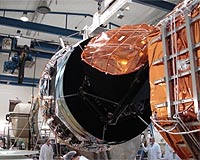
Paris, France (SPX) Nov 24, 2008 The thermal balance and thermal vacuum (TBTV) test campaign for the Planck spacecraft has been completed. During this campaign the spacecraft and payload were subjected to near-flight conditions inside a thermal vacuum chamber at the Centre Spatiale de Li�ge (CSL) test facilities. Over the course of about five weeks the spacecraft and payload were cooled down to operational temperatures. The extremely low operational temperature required for the HFI instrument was achieved on 22 July 2008 when the HFI bolometers reached 0.1 K The Planck payload comprises two instruments: the High Frequency Instrument (HFI) and the Low Frequency Instrument (LFI). In order to take scientific measurements with the intended level of sensitivity, the detectors in the focal plane unit (FPU) of both instruments need to be cooled - to 20 K for the LFI and 0.1 K for the HFI. The design of the Planck spacecraft allows for passive cooling down to 50 K through radiative heat dissipation, with the payload module and telescope shielded from the warm spacecraft components by three progressively colder V-grooves. To reach lower temperatures the spacecraft carries an active cryogenic cooling chain that is comprised of several stages: + A sorption cooler which lowers the temperature to 20 K for the LFI FPU and 18 K for the HFI FPU for pre-cooling + A Joules-Thompson cooler brings the HFI FPU down to 4 K + A 3He 4He dilution cooler reduces the temperature of the HFI bolometers to 0.1 K + An intermediate stage at 1.6 K lies within the 4 K enclosure of the HFI FPU and is used to keep different filters of the HFI instrument at 1.6 K.
TBTV test campaign at CSL One of the objectives of the TBTV test campaign was to verify that Planck's sophisticated active cryogenic cooling system achieves the correct temperatures (down to 0.1 K - a tenth of a degree above absolute zero) and that the scientific detectors demonstrate the required performance. Shortly after the closure of the FOCAL-5 chamber on 16 June 2008 the spacecraft's active cryogenic chain was initiated to help pre-cool the different stages simultaneously. For the test campaign the cooldown was sped up (taking place over a five week period) compared to how the spacecraft will reach its operational temperatures in space: after its launch into space Planck will gradually cool down over a period of several months during its journey to L2.
Reaching and maintaining 0.1 K Planck's different temperature stages are each equipped with thermometers to monitor the temperature of the associated stage. For the 0.1 K stage special high sensitivity fine thermometers are used to monitor the temperature stability. These fine thermometers only work below 0.12-0.15 K. Figure 3 shows the temperature measured by the fine thermometers within the HFI FPU for the period 22 July to 6 August 2008. The sharp spikes (both up- and down-ward) are readout noise from the measurement system and not real temperature spikes. Following the successful completion of the TBTV test campaign the whole spacecraft was brought back to room temperature in several stages and the FOCAL-5 chamber was opened again on 19 August 2008. The Planck spacecraft was removed from the chamber the following day. The Planck spacecraft remains at CSL where it is undergoing a series of functional tests before being prepared for shipment to the launch site early next year. These tests include an integrated satellite test, a system validation test, and a system operation validation test. In addition the qualification model of the solar array that has been used during the TBTV test campaign will be removed and the flight model of the solar array will be integrated with the Planck spacecraft. Share This Article With Planet Earth
Related Links Centre Spatiale de Li�ge (CSL) Planck spacecraft Understanding Time and Space
 The Thousand-Ruby Galaxy
 Paris, France (ESO) Sep 03, 2008
ESO's Wide Field Imager has captured the intricate swirls of the spiral galaxy Messier 83, a smaller look-alike of our own Milky Way. Shining with the light of billions of stars and the ruby red glow of hydrogen gas, it is a beautiful example of a barred spiral galaxy, whose shape has led to it being nicknamed the Southern Pinwheel. |
|
|

| The content herein, unless otherwise known to be public domain, are Copyright 1995-2007 - SpaceDaily.AFP and UPI Wire Stories are copyright Agence France-Presse and United Press International. ESA Portal Reports are copyright European Space Agency. All NASA sourced material is public domain. Additional copyrights may apply in whole or part to other bona fide parties. Advertising does not imply endorsement,agreement or approval of any opinions, statements or information provided by SpaceDaily on any Web page published or hosted by SpaceDaily. Privacy Statement |
 del.icio.us
 Digg
Digg Reddit
 YahooMyWeb
 Google
 Facebook