|
 |
 |
 |
 |
 |
 |
 |
 |

 |
Polar Bear Researchers Urge Caution In Hunting Policy
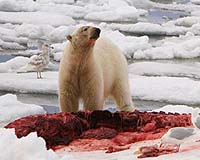
Edmonton, Canada (SPX) Nov 27, 2007 New research by the University of Alberta in Edmonton, Canada, suggests that current wildlife management practices in Canada could make it harder for polar bears to find mates. Harvesting regulations vary around the world, notes PhD student Peter Moln�r of the Department of Biological Sciences, the study's lead author. For example, Canada uses a quota system, permitting some hunting to a predetermined limit, while Norway bans any hunting of polar bears. Current Canadian management polices encourage hunters to go after male bears in order to conserve females while maximizing the number of bears that may be harvested. But harvesting based on sex selection has reduced the number of males compared to females in polar bear populations across the Canadian Arctic, Moln�r says. Moln�r's work was supervised by Professor Andrew Derocher, a noted polar bear expert, and Professor Mark Lewis, who holds the Canada Research Chair in Mathematical Biology. The study was conducted in collaboration with Dr. Mitchell Taylor from the Government of Nunavut. Their findings appeared Wednesday in the online edition of the Proceedings of the Royal Society, an academic journal based in the United Kingdom. The U of A team warns that under certain conditions, this practice of sex-selective harvesting could lead to trouble when it comes to polar bears finding a mate - based on a biological mathematical model they developed, and data from the polar bear population at Lancaster Sound off Cornwallis Island (northwest of Baffin Island) in the High Arctic. The mathematical model has given the researchers the ability to predict how many male bears are needed in an area compared to the number of female bears that are around, to maintain successful mating. They determined that there is a critical threshold in the male-to-female ratio. If the sex ratio drops below this threshold, the model predicts a sudden and rapid collapse in fertilization rates. This threshold depends on whether the area has a high-density or low-density bear population. Each bear population must be evaluated separately, since results will be different depending on the population characteristics of the area. But the U of A scientists can say that in regions with fewer bears travelling a larger area (low-density population), there actually needs to be more males than breeding females to maintain high fertilization rates. Given this important population threshold, the authors concluded that polar bear populations should be closely monitored and carefully harvested, as severe negative effects could arise either from overharvesting male bears or from population decline. Community Email This Article Comment On This Article Related Links University of Alberta Darwin Today At TerraDaily.com
 Scientists Melt Million-Year-Old Ice In Search Of Ancient Microbes
 Newark DE (SPX) Nov 27, 2007
Researchers from the University of Delaware and the University of California at Riverside have thawed ice estimated to be at least a million years old from above Lake Vostok, an ancient lake that lies hidden more than two miles beneath the frozen surface of Antarctica. The scientists will now examine the eons-old water for microorganisms, and then through novel genomic techniques, try to figure out how these tiny, living "time capsules" survived the ages in total darkness, in freezing cold and without food and energy from the sun. |
|
|
| The content herein, unless otherwise known to be public domain, are Copyright Space.TV Corporation. AFP and UPI Wire Stories are copyright Agence France-Presse and United Press International. ESA Portal Reports are copyright European Space Agency. All NASA sourced material is public domain. Additional copyrights may apply in whole or part to other bona fide parties. Advertising does not imply endorsement, agreement or approval of any opinions, statements or information provided by Space.TV Corp on any Web page published or hosted by Space.TV Corp. Privacy Statement |